Operations | Monitoring | ITSM | DevOps | Cloud

What developers get, out-of-the-box, from the most generous free plan anywhere

Freemium plans are a great way for companies to introduce developers to their products and offer a hands-on demonstration of the value they provide. But it can be extremely frustrating for developers when a free tier limits access to key features or doesn’t provide enough capacity to evaluate how the product performs in real-world development scenarios.

How Automated Application Monitoring Saves Time and Money

With the increase in demand for technology and quality assurance, companies are looking to improve their products day by day. For many, time and workforce are limited, so companies are interested in solutions that automate their day-to-day work. Whether developing software or testing it, almost every part of application lifecycle management is reliable on the human workforce. But some parts like monitoring, tracking, and alerting can be automated using some latest software.

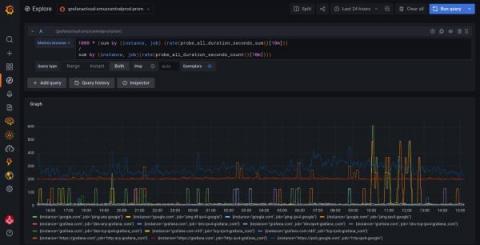
Top 5 user-requested synthetic monitoring alerts in Grafana Cloud

We often hear from Grafana Cloud users who are asking for guidelines on how to write better alerts on synthetic monitoring metrics and get notified when synthetic monitoring detects a problem. We already ship a predefined alert in Grafana Cloud synthetic monitoring. A predefined alert that we ship is alerting on the probe_all_success_sum metric and makes use of the alert sensitivity config to create multiple Grafana Cloud alerting rules. Check out synthetic monitoring alerting docs for details.

Podcast: Break Things on Purpose | Unpopular Opinions

Time for a bit of a review! Join Jason as he looks back on some previous guests who have shared some opinions that range from the idiosyncratic to down right unpopular. Pulling from a handful of “Breaking Things” interviews, Jason covers death to VPNs, to the validity of “AI Ops,” check out the litany!

Config best practices: Docker layer caching

Let’s face it: Creating the optimal CI/CD workflow is not always a simple task. In fact, writing effective and efficient configuration code is the biggest hurdle that many developers face in their DevOps journey. But you don’t need to be an expert to set up a fast, reliable testing and deployment infrastructure. With a few straightforward techniques, you can optimize your config.yml file and unleash the full potential of your CI/CD pipelines.

Comparing REST and GraphQL Monitoring Techniques

Maintaining an endpoint, especially a customer-facing one, requires constant monitoring, whether using REST or GraphQL. As the industry has looked for solutions to build a more adaptive endpoint technology, it is also a must to monitor these endpoints. GraphQL and REST are two different technologies that allow user-facing clients to link to databases and platform logic. Both GraphQL and REST include monitoring techniques.

Data Federation and the Modern Enterprise

In our increasingly hyper-connected, data-dependent world, it can be difficult to keep track of where resources are, how to access them, and how to put data assets to work to run a more efficient and reliable enterprise. Traditional approaches to IT operations analytics are becoming outmoded as the sources and types of data grow more mobile, ephemeral, diverse and distributed.

What is Cloud Backup and How Does It Help Small Business?

Cloud technology has enjoyed exponential growth over the past several years. Increases in broadband and wireless speeds have spurred a rise in everything from cloud storage to Software-as-a-Service (SaaS). Before the cloud grew into its current form, it was primarily a tool for backing up data in a safe, remote location. Throughout the evolution of cloud, backup and restore remains one of this technology’s most widely-used and important functions.

How to measure the performance of a website

If you’re a person who works from home, you almost certainly have to deal with occasional internet connection issues. More often than complete outages, you’re likely dealing with occasional slowness. And you know from experience that any one of dozens of devices and services along the path can cause latency.

Why cloud native requires a holistic approach to security and observability

Like any great technology, the interest in and adoption of Kubernetes (an excellent way to orchestrate your workloads, by the way) took off as cloud native and containerization grew in popularity. With that came a lot of confusion. Everyone was using Kubernetes to move their workloads, but as they went through their journey to deployment, they weren’t thinking about security until they got to production.