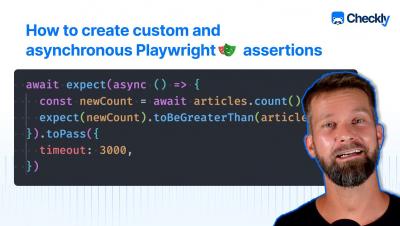
How to create custom assertions with Playwright's "toPass()" method
Learn how to use Playwright's "toPass" method to create auto-repeating and asynchronous assertions.


The latest News and Information on Software Testing and related technologies.
Grafana k6 is a powerful, developer-friendly tool designed and engineered with a focus on load testing — but it boasts capabilities that extend far beyond that use case. Understanding the inner workings of k6 is helpful to fully leverage its potential, and to tailor the tool to your specific testing needs. Read on to learn how k6 is structured, and how its underlying design provides the best possible reliability and load testing experience.
Just conducting one type of testing is generally not enough. For example, let’s say you decide to perform unit testing only. However, unit tests only verify business logic. Many other types of tests exist to verify the integration between components, such as integration tests. But what if you want to measure the maximum performance of your application? Or what if you want to know how the application behaves under extreme stress?
Effective mobile application testing that meets all the requirements of modern quality assurance can be challenging. Not only do teams need to create tests that cover a range of different device types, operating system versions, and user interactions—including swipes, gestures, touches, and more—they also have to maintain the infrastructure and device fleets necessary to run these tests.