Operations | Monitoring | ITSM | DevOps | Cloud

How to operate shared platforms safely at agent scale

A platform engineering team can design robust Golden Paths for agent use yet still be unprepared for what happens after adoption. An agent may authenticate properly, call the correct tools, adhere to approval gates, and complete tasks without incident, but new operational risks arise once multiple teams begin running agents continuously and in parallel. We’ve encountered these risks firsthand at Datadog.

Monitor TAS and gang scheduling for AI training in Kubernetes

Distributed AI training workloads impose complex scheduling requirements that Kubernetes’s built-in scheduler can’t meet. Kubernetes schedules pods individually and independently, but distributed training introduces two requirements that break this model: Pods must land on hardware with the right inter-GPU bandwidth, and all pods must be scheduled simultaneously. If either requirement goes unmet, training stalls or runs far below the hardware’s potential.

Manage Cursor costs with Datadog Cloud Cost Management

AI coding tools such as Cursor are becoming a significant source of engineering spend. But Cursor costs can be difficult for FinOps teams to manage. Cursor’s usage data alone doesn’t tell you how costs break down across users and models, and fixed-threshold alerts may not catch an unusual cost spike if spend remains below the threshold. Datadog Cloud Cost Management (CCM) brings Cursor costs into the same place where you monitor cloud, SaaS, and other AI spend.

Bindplane Agent Is Here: Build, Edit, and Understand Pipelines in Plain Language

Pipeline Intelligence already recommends processors, reads live telemetry, detects log types, and generates processor bundles from natural language. But most of it lives inside a single processor node. You still have to know which one to open and what to ask for. This changes today. Bindplane Agent is your AI assistant inside Bindplane, ready to act on what you describe in plain language.

150+ AI statistics for 2026: spend, cost, and AI ROI

Worldwide AI spending will reach $2.59 trillion in 2026, up 47% from 2025, according to Gartner. Yet only 37% of organizations report any earnings impact from AI, McKinsey finds. These AI statistics cover what companies spend, what AI costs to run, and the ROI they're actually getting. That gap between the two headline numbers is the story of AI in 2026.

From a $60K invoice to a $200B earnings call, few can explain the AI bill

CloudZero’s own AI Economics Pulse for September found the 75th percentile of its 430-company customer panel crossed 10% of its cloud bill on AI for the first time in August. Gartner’s latest survey found only 22% of organizations have scaled AI successfully and 11% don’t know what their own function spent on it last year. CJ Gustafson showed what that gap looks like on an actual invoice this week.

The 12 Point Checklist Before Your AI Voice Agent Takes Live Calls

You have tested your AI voicebot solutions for weeks. The calls sound natural, the answers are accurate, and the demo works exactly as planned. Then you put it on a live call. A caller interrupts while the agent is speaking. Speech recognition misses an account number. An API takes three seconds to respond. The LLM slows down under load. One service fails, and suddenly your polished voice agent has no idea what to do next.

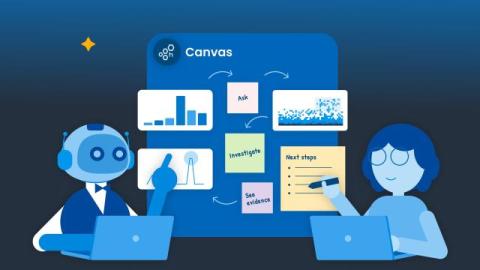
How Canvas Powers the AI Agent Development Feedback Loop

For teams building AI agents, the feedback loop should already be a familiar idea: watch how the agent behaves, find what needs improvement, ship a change, and measure the result. In theory, each turn builds on the last until the loop becomes a flywheel and your agent is getting more effective with each turn. In practice, many of us are still in reaction mode. A user reports something strange, costs spike, or an eval score drops.

First Look: Build Grafana Dashboards with AI using the MetricFire MCP Server

Get a first look at what’s coming next to the MetricFire MCP Server: AI-powered dashboard creation and management. We’re connecting the Hosted Graphite HTTP Dashboard API to our MCP Server, letting compatible AI clients work with your monitoring data and Grafana dashboards directly through an AI-assisted workflow. Soon, you’ll be able to use natural language prompts to reference metrics stored in Hosted Graphite and create, update, and manage dashboards.

ilert AI SRE is generally available

When you get paged at 3am, it takes about 30 seconds for the notification to reach you and maybe two minutes until you're in front of a laptop, awake enough to read. What you see then is usually a raw alert. A metric name, a threshold, a link to a dashboard. Then the ritual starts: open the dashboard, check what deployed in the last few hours, grep the logs for the first error, ask in Slack whether anyone touched the database. ‍ Most of that time is search.