Grafana Cloud updates: onboard teams with new AI-powered tooling, secrets management for enhanced security, and more

We consistently roll out helpful updates and fun features in Grafana Cloud, our fully managed observability platform powered by the open source Grafana LGTM Stack (Loki for logs, Grafana for visualization, Tempo for traces, and Mimir for metrics). In case you missed them, here’s our monthly round-up of the latest and greatest Grafana Cloud updates. You can also read about all the features we add to Grafana Cloud in our What’s New in Grafana Cloud documentation.

How to monitor Claude usage and costs: introducing the Anthropic integration for Grafana Cloud

Generative AI is becoming a core part of modern applications, making it essential to monitor and manage how these services are used. That’s why, today, we’re excited to introduce the Anthropic integration for Grafana Cloud, a new solution that lets you connect directly to the Anthropic Usage and Cost API from within Grafana Cloud.

Why Alert Fatigue is a Major Challenge in Observability (2025 Survey Insights) | Grafana Labs

Over 1,200 engineers, leaders, and teams shared their biggest observability challenges in our third annual Observability Survey — and the results are in. In this video, Marc Chipouras (Head of Emerging Products, Grafana Labs) breaks down the top insights: Thanks for watching!

The first rule of DORA Metrics...

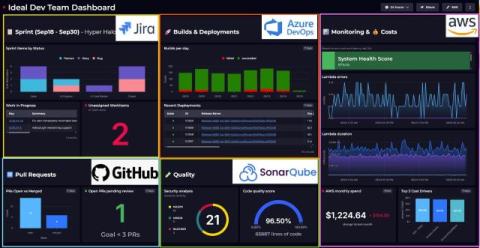
DORA Metrics are widely regarded as the gold standard for measuring the performance of software development teams. The metrics themselves though are generic, high-level pointers – they are not an instruction manual. Adopting the DORA approach is the first step down the path to continuous improvement. The next steps are deciding how the measures should be defined in the context of your own organisations processes and then figuring out how to retrieve (and present) the relevant data.

Integrating Deno and Grafana Cloud: How to observe your JavaScript project with zero added code

Andy Jiang is a JavaScript engineer with nearly 10 years of experience. He’s interested in making JavaScript and TypeScript simpler to use. He currently works at Deno as a product marketing manager. Outside of work, Andy likes cooking, writing, and playing tennis. Observability is essential for modern applications. Metrics, logs, and traces allow you to troubleshoot production issues, monitor performance, and understand usage patterns.

Getting Started with Grafana Cloud's AI Assistant for Observability

The pace of software delivery in 2025 is unprecedented — cloud-native apps, microservices, and AI-generated code are shipping in days, not months. But one challenge never changes: ensuring reliability and visibility when systems fail. In this video, we explore how the new Grafana AI Assistant brings true, context-aware observability to your stack. Watch as we deploy an open-source Python service with Kafka, Postgres, Kubernetes, and Prometheus then use the AI assistant to instantly generate dashboards, alerts, and reduce un-needed telemetry volume.

AI in observability at Grafana Labs: Making observability easy and accessible for everyone

Did you know that observability has been around for more than six decades? It all goes back to a Hungarian-American inventor named Rudolf Kálmán who thought about how external outputs could measure the internal state of a machine. Kálmán wrote about monitoring single-input single-output systems, but our demands are very different today. We need to observe monoliths, microservices, clusters, pods, regions, and many more.