Operations | Monitoring | ITSM | DevOps | Cloud

The latest News and Information on DevOps, CI/CD, Automation and related technologies.

Run Azure Functions locally in Visual Studio 2022

Azure Functions offers a serverless solution that streamlines the development process, minimizes infrastructure overhead, and results in cost savings. The beauty of this approach is that you no longer need to grapple with server deployment and maintenance; the cloud infrastructure automatically furnishes the essential resources to support your applications.

Azure Event Grid dead letter monitoring

Microsoft Azure provides a completely managed event routing service called Azure Event Grid. It allows you to respond to events received from various Azure services and external applications and forward them to different Azure services and endpoints. Azure Event Grid provides a unified way to manage events in Azure with event-driven programming. With Event Grids, you can create event-driven applications in a serverless environment, cutting down costs and performance lags.

31 Crucial DevOps Automation Tools Your Team Needs In 2023

As technology advances and business environments become increasingly competitive, your DevOps team has to continuously improve your product. The challenge is to free up their time so that they can release new product features and improve existing ones. Automating repetitive tasks is one way to accomplish this. Manual approaches also tend to generate or miss errors, slow time to market, and fail to test and monitor system health quickly enough.

How to ensure your Kubernetes Pods have enough memory

Memory (or RAM, short for random-access memory) is a finite and critical computing resource. The amount of RAM in a system dictates the number and complexity of processes that can run on the system, and running out of RAM can cause significant problems, including: This problem can be mitigated using clustered platforms like Kubernetes, where you can add or remove RAM capacity by adding or removing nodes on-demand.

Canonical releases Charmed MLFlow

London, United Kingdom, 26 September 2023. Canonical announced today that Charmed MLFlow, Canonical’s distribution of the popular machine learning platform, is now generally available. Charmed MLFlow is part of Canonical’s growing MLOps portfolio. Ideal for model registry and experiment tracking, Charmed MLFlow is integrated with other AI and big data tools such as Apache Spark and Kubeflow. The solution runs on any infrastructure, from workstations to public and private clouds.

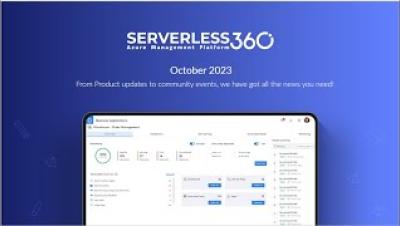
Monitor multiple Azure subscriptions in a single dashboard

Multiple Azure subscriptions are typically managed by a Tenant in an enterprise. Each subscription is tailored to a specific product, project, module, or environment. This article addresses the utilization of Serverless360 for the monitoring and managing these diverse Azure subscriptions.

Infrastructure Monitoring Today: How It Works & What It Does

The famous phrase “Houston, we’ve had a problem” isn’t a one off event for space missions or Tom Hanks — its a regular occurrence for most IT teams! Today’s IT teams are peppered with alerts indicating that something has gone amiss in their production environments. Visibility of uptime and performance is an essential part of ensuring that your IT infrastructure can power applications to meet business needs and deliver value for users.

Operationalizing Kubernetes within DoD - Civo Navigate NA 2023

Join Ryan Gutwein of the Ignite Assurance Platform as he dives deep into the DoD's journey of operationalizing Kubernetes, navigating governance challenges, and the transformation from traditional compliance to action-driven modernization. Discover the latest in software factories, component aggregation, and see demonstrations of platforms shaping the future of DoD tech.

Netdata, Prometheus, Grafana Stack

In this blog, we will walk you through the basics of getting Netdata, Prometheus and Grafana all working together and monitoring your application servers. This article will be using docker on your local workstation. We will be working with docker in an ad-hoc way, launching containers that run /bin/bash and attaching a TTY to them. We use docker here in a purely academic fashion and do not condone running Netdata in a container.

Cycle's New Interface Part III: The Future is LowOps

We recently covered some of the complex decisions and architecture behind Cycle’s brand new interface. In this final installment, we’ll peer into our crystal ball and glimpse into the future of the Cycle portal. Cycle already is a production-ready DevOps platform capable of running even the most demanding websites and applications. But, that doesn’t mean we can’t make the platform even more functional, and make DevOps even simpler to manage.