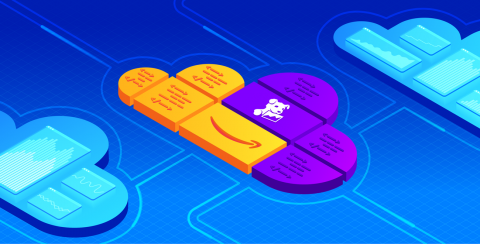
Deploying and configuring Datadog with CloudFormation
In this post, we will show you how you can use AWS CloudFormation to automatically deploy infrastructure that is preconfigured to send metrics and logs to Datadog.


The latest News and Information on DevOps, CI/CD, Automation and related technologies.
In this post, we will show you how you can use AWS CloudFormation to automatically deploy infrastructure that is preconfigured to send metrics and logs to Datadog.
A Docker image contains an application and all its dependencies. As it also contains the numerous binaries and libraries of an OS, it’s important to make sure no vulnerabilities exist in its root filesystem, or at least no critical or major ones. Scanning an image within a CI/CD pipeline can ensure this additional level of security.
DevOps is an ongoing process requiring constant communication, collaboration, and automation. Teams must be able to move projects from conceptualization to release as quickly and as efficiently as possible. Not only do organizations need to have workflows in place to facilitate DevOps, but they also need the right tools.
With the start of the new year, it is a good time to look at what changes have happened in our industry over the last 12 months. With the help of a few recent industry surveys and some of our own perspective, I’d like to summarize some of the key trends that we are seeing.
This blog describes steps to migrate Rancher 2.1.x from a single node installation to a high availability installation.
I talk a lot about containerd. I write blog posts about it, speak at conferences about it, give introductory presentations internally at IBM about it and tweet (maybe too much) about it. Due to my role at IBM, I’ve helped IBM’s public cloud Kubernetes service, IKS, start a migration to use containerd as the CRI runtime in recent releases and similarly helped IBM Cloud Private (our on-premises cloud offering) offer containerd as a tech preview in the past two releases.
It’s the beginning of a new year and when it comes to computing, going serverless is the resolution of many engineering teams. At Stackery, this excites us because we know how significant the positive impacts of serverless are and will be. So much, in fact, that we’re already thinking about its applications for next year and beyond.
This blog describes how Rancher and its managed kubernetes clusters can be affected by the recent announcement detailing the vulnerabilities of the proxying external IPs and dashboard.
As the CEO of Stackery, I have had a unique, inside view of serverless since we launched in 2016. I get to work alongside the world’s leading serverless experts, our customers, and our partners and learn from their discoveries. It’s a new year: the perfect time to take stock of professional progress, accomplishments, and goals.