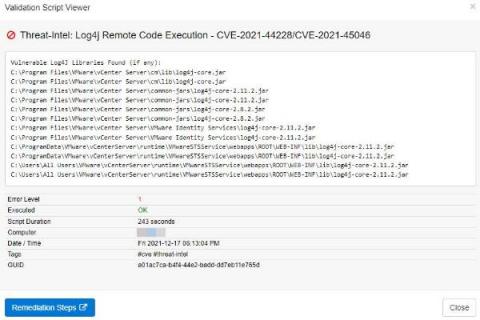
If you have access to the internet, it’s likely that you have already heard of the critical vulnerability in the Log4j library. A zero-day vulnerability in the Java library Log4j, with the assigned CVE code of CVE-2021-44228, has been disclosed by Chen Zhaojun, a security researcher in the Alibaba Cloud Security team. It’s got people worried—and with good reason.
The internet has been ablaze since the announcement of Log4Shell, the nickname for CVE-2021-44228, an arbitrary remote code execution vulnerability in the Java logging utility Log4j. So far two additional vulnerabilities ( CVE 2021-45046, CVE-2021-45105) have now been identified. The code has been vulnerable since 2013 and millions of hosts and services are affected.
This post originally appeared on The New Stack and is re-published here with permission. In our technology-driven business climate, most companies have at least some, if not all, workloads on the cloud. And unlike on-premises networks, these cloud environments lack secure outer perimeters and specific off times. Cloud networks are always on and always available. While convenient, this also means hackers can access them at any time.
Just when the Microsoft Exchange exploit CVE-2021-26855 thought it would win the “Exploit of the year” award, it got unseated by the – still evolving – Log4J exploit just weeks before the end of the year! Had somebody asked Sysadmins in November what Log4J was then I suspect that the majority would have had no idea. It seems that the biggest challenge the Log4J exploit poses for Sysadmins is simply the fact that nobody knows all the places where Log4J is being used.
On December 9, 2021, a vulnerability was reported that could allow a system running Apache Log4j 2 version 2.14.1 or below to be compromised and allow an attacker to execute arbitrary code on the vulnerable server. This vulnerability was registered on the National Vulnerability Database as CVE-2021-44228, with a severity score of 10. Here is a diagram of the attack chain from the Swiss Government Computer Emergency Response Team (GovCERT).
At Avantra, our customers trust us to keep their business operations based on SAP running smoothly. I have written in the past about the importance of SAP security, and how I believe that in the next few years, SAP risks becoming an attack vector for hackers. It should come as no surprise that security is an area in which Avantra has invested significantly since I became CEO.