Operations | Monitoring | ITSM | DevOps | Cloud

Dark Data: Discovery, Uses, and Benefits of Hidden Data

Dark data is all of the unused, unknown and untapped data across an organization. This data is generated as a result of users’ daily interactions online with countless devices and systems — everything from machine data to server log files to unstructured data derived from social media. Organizations may consider this data too old to provide value, incomplete or redundant, or limited by a format that can’t be accessed with available tools.

Data Lakes Explored: Benefits, Challenges, and Best Practices

A data lake is a data repository for terabytes or petabytes of raw data stored in its original format. The data can originate from a variety of data sources: IoT and sensor data, a simple file, or a binary large object (BLOB) such as a video, audio, image or multimedia file. Any manipulation of the data — to put it into a data pipeline and make it usable — is done when the data is extracted from the data lake.

Pipeline Efficiency: Best Practices for Optimizing your Data Pipeline

Data pipelines are the foundational support to any business analytics project. They are growing more critical than ever as companies are leaning on their insights to drive their business: 54% of enterprises said it was vital to their future business strategies. Data pipelines play a crucial role as they perform calculations and transformations used by analysts, data scientists, and business intelligence teams.

Flatten the SPL Learning Curve: Introducing Splunk AI Assistant for SPL

At.conf23, we announced the preview release of Splunk AI Assistant - Splunk's first offering powered by generative AI. This app offers an intuitive and easy-to-use chat experience to help you translate a natural language prompt into SPL query that you can execute or build on, all within a familiar Splunk interface. Splunk AI Assistant also explains what a given SPL query is doing in plain English with a summary as well as a detailed breakdown of the query.

What Is Adaptive Thresholding?

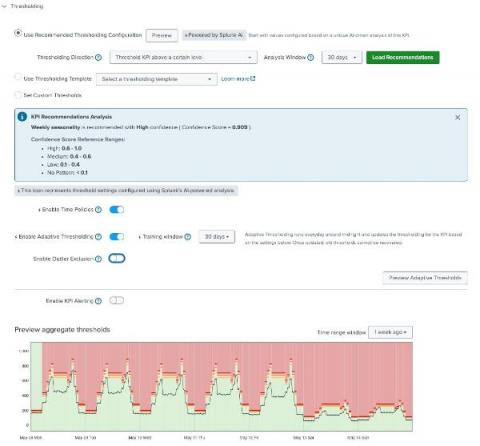
Adaptive thresholding is a term used in computer science and — more specifically — across IT Service Intelligence (ITSI), for analyzing historical data to determine key performance indicators (KPIs) in your IT environment. Among other things, it’s used to govern KPI outliers in an effort to foster more meaningful and trusted performance monitoring alerts.

Splunk Edge Processor Enhancements Offer Greater Data Access and Improve Data Management

On the heels of an exciting GA in March and the April announcement of its regional expansion, we are excited to share the latest updates to Splunk Edge Processor that will make it even easier for customers to have more flexibility and control over just the data you want, nothing more nothing less.

Fastest Time-to-Value Anomaly Detection in Splunk: The Splunk App for Anomaly Detection 1.1.0

Anomaly detection in metrics or time series data is the most used machine learning use case among Splunk Security and Observability customers. Customers are looking for easy-to-use ML-powered high-fidelity anomaly detection, so that they can be alerted at the first sign of a failure point or security incident.

Data Lifecycle Management: A Complete Guide

Data has become an essential asset for businesses, driving innovation, improving decision-making, and shaping the future. But how does one effectively manage this valuable resource? This is where Data Lifecycle Management (DLM) comes in — a comprehensive approach to managing data throughout its lifecycle. This blog post will guide you through the ins and outs of DLM, its key stages, benefits, and the tools and technologies that enable successful implementation. Let's dive in!

Control Plane vs. Data Plane: Use Cases, Advantages & Drawbacks

The control plane and the data plane are two key components of a network, each facilitating the flow of network packets, and each with its own set of functions and responsibilities. Understanding the differences between these two planes helps you design and optimize networks for improved performance, scalability, and security. This article will explore the control and data planes, including their functionalities, fundamental differences and use cases.