Operations | Monitoring | ITSM | DevOps | Cloud

Revolutionize Product Development with Feedback-Driven Customer Advisory Boards

In a rapidly evolving business landscape, understanding and responding to customer needs is not just an advantage — it's a necessity. At Splunk, we've taken a bold step by applying a product manager mindset to our Customer Advisory Board (CAB) program, transforming it into a dynamic platform for both customers and our product teams.

Tiered Observability: How To Prioritize and Mature Observability Investments

You may be surprised that delivering observability is a journey and isn’t about observing everything at once — it’s about driving outcomes like proactive detection, faster troubleshooting, and aligning with business priorities. If you’ve followed this series, you’ve already taken steps to.

AI Governance in 2025: A Full Perspective on Governance in Artificial Intelligence

In a world where artificial intelligence (AI) is leaping forward — growing at a CAGR of almost 36% from 2024 to 2030 — questions about governance and ethics with the use of AI are surfacing. As humans continue to develop AI systems, it is crucial to establish proper guidelines to ensure powerful technologies like generative AI and adaptive AI are used in a responsible manner.

How To Monitor Kubernetes with Splunk Infrastructure Monitoring

Kubernetes is the standard for orchestrating containerized microservices — but it can present some monitoring challenges. Luckily, we’ve already covered why monitoring Kubernetes is a must-do, the basics of how to do it, and the options you have for collecting monitoring data from a K8s environment.

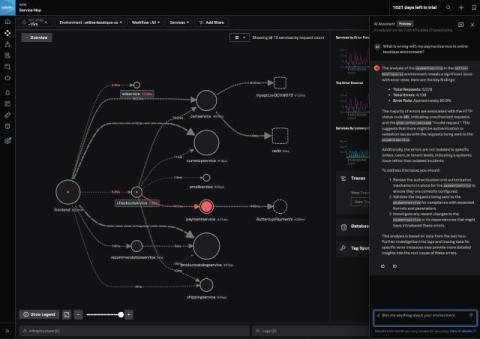
Solve Problems Faster with New, Smarter AI and Integrations in Splunk Observability

As businesses scale across hybrid and multi-cloud environments and integrate AI-powered technologies, complexity grows — and with it, the risk of performance degradation and cost of downtime. To avoid facing customer-impacting IT issues, organizations need better ways to correlate data across environments, detect anomalies before they escalate, and resolve incidents more efficiently. That’s where Splunk and Cisco come in.

APAC in 2025: A Harder Look at AI, Data and Cybersecurity Standards

This year has been transformative for technology, reshaping the business landscape with groundbreaking advancements and unprecedented challenges. Generative AI continues to unlock new possibilities, while cybersecurity threats have escalated to new heights. Across APAC — a fast-emerging global innovation hub — businesses have grappled with the twin forces of regulatory evolution and technological breakthroughs.

Learn SPL Command Types: Efficient Search Execution Order and How to Investigate Them

When performing searches, Splunk uses its own language, SPL (Search Processing Language). SPL commands can be categorized into several types depending on the processing they perform. Especially in a distributed environment where the Splunk system is made up of multiple servers, if you do not understand which components perform heavy processing depending on the SPL type, you may create inefficient searches.

Business Intelligence (BI): What It Means for Your Organization

Data drives the modern business world, and organizations capable of leveraging it effectively maintain a significant edge over their competition. Business Intelligence (BI) has emerged as a critical tool, enabling companies to turn raw data into actionable insights. But what exactly is BI? This blog explores everything you need to know about business intelligence, from its components to use cases, to implementation strategies.

Splunk AppDynamics 24.10 Accelerates Deployment And MTTR

Splunk AppDynamics, now part of the Splunk Observability portfolio, provides critical observability for traditional 3-tier/n-tier applications and helps IT Operations teams quickly discover root causes of issues before end-users even notice. AppDynamics complements Splunk Observability Cloud, which is optimized for observing cloud-native applications by DevOps and engineering teams.