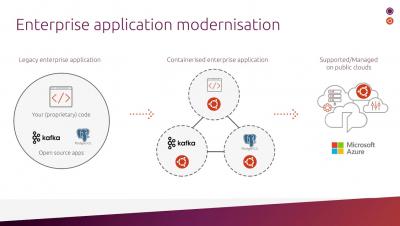
Enterprise App Modernisation for AKS
The AKS Migration Assessment will help you assess your organisation's readiness to move its applications to cloud native platforms like AKS, and to plan and estimate costs.


Canonical provides customers Ubuntu Pro images AWS Marketplace. Ubuntu Pro for AWS is a premium AMI designed by Canonical to provide additional coverage for production environments running in the cloud. It includes security and compliance services, enabled by default, in a form suitable for small to large-scale Linux enterprise operations — with no contract needed.
A new start? 2020 came and went, and in the process, it left a mark in history and our lives that won’t be erased. Together, as a community, we all struggled, we all faced new challenges, we all united and did our best to help each other. We are grateful for the effort of our nurses, doctors, carers, scientific, essential workers, and innovators that have led this fight. We also take a moment to remember those that we have lost and those who have been affected the most.
Following the GA of Kubernetes 1.19 support in AWS, EKS-optimized Ubuntu images for 1.19 node groups have been released. The ami-id of this image for each region can be found on the official site for Ubuntu EKS images.
Red Hat Gluster Storage is a distributed file system, built on GlusterFS and operated by Red Hat for Linux environments. With its focus on scalability, low cost, and deployment flexibility across physical, virtual, and cloud-based environments, organizations use Gluster Storage in a variety of high-scale, unstructured data storage applications.
Everyone loves a clean, tidy home (hopefully). This also includes your other home – slash home, the Linux home directory. Disk cleanup and management utilities are extremely popular in Windows, but not so much in Linux. This means that users who want to do a bit of housekeeping in their distro may not necessarily have a quick, convenient way to figure out how to get rid of the extra cruft they have accumulated over the years. Let us walk you through the processing of slimming down your home.
Within just five years, Kubernetes and containers have redefined how software is deployed. Researchers expect the container market to grow by 30% year over year to become a 5 billion industry by 2022. But what is the reason behind this mass adoption of container technology in the enterprise? Download whitepaper Containers are more resource efficient than virtual machines or other legacy app architectures.
Hybrid cloud allows businesses to optimise their costs associated with cloud infrastructure maintenance. It also brings many other benefits, such as business continuity, compliance, better scalability and improved agility. According to the Forrester Wave: Hybrid Cloud Management, Q4 2020, hybrid cloud is an essential technology that every modern organisation is looking for and its adoption is only expected to grow in the following years.
Portainer is an open source tool that allows for container deployment and management without the need to write code. In their recent publication, ‘How to deploy Portainer on MicroK8s’, the Portainer team share with the community how easy and fast it is to deploy Portainer on MicroK8s. In fact, the entire process only requires a single command! For a step-by-step walkthrough of the process, take a look at Portainer’s 5 minute video below. Install MicroK8s