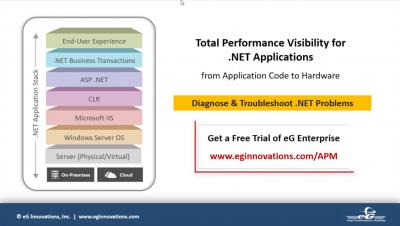
Microsoft .NET Framework is one of the most popular application development platforms and programming languages. C# and ASP.NET frameworks are used by millions of developers for building Windows client applications, XML Web services, distributed components, client-server applications, database applications, and so on. It’s no surprise that ensuring top-notch performance of .NET applications is a foremost need for most application owners and developers.
In A Comedy of Errors, we talk to engineers about the weirdest, worst, and most interesting application and infrastructure issues they’ve encountered (and resolved) over the years. This week, we hear from Jason Dufair, Full Stack Developer on the Studio team at Purdue University.
As a pillar of the .NET ecosystem, NuGet specifies how .NET packages are created, hosted, and consumed, while also providing the necessary tools to achieve these functions. Despite being relatively new (launched in 2010), all project templates from Microsoft’s Visual Studio have included packages that required NuGet.org for several years.
We are excited to announce our recent support of .NET Standard 2.0 and ASP.NET Core 2 applications for Raygun Crash Reporting. The update is for developers needing to target the .NET Standard 2 APIs. Our new provider targets both .NET Standard 1.6 and .NET Standard 2.0, so it can be used with both .NET Core 1 and .NET Core 2 applications. At the time of writing, it is just the .NET Core provider and ASP.NET Core provider that are .NET Core 2 compatible.
We published open-source, simple and easy to use .NET Standard 2.0 library with some useful utilities.
Exception handling is a crucial mechanism of application development. When exceptions occur frequently, things like increased CPU time consumption, memory leakage, and application slowness have a higher chance of happening. In case of uncaught exceptions, the application's run time can terminate. If an application can handle various exception types, it will be more robust and less prone to crashing.