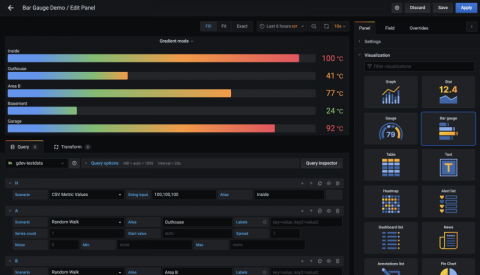
We are thrilled to announce that Grafana 7.0 has been released for general availability. Join us as Torkel Ödegaard, the creator of Grafana, hosts a full demo of 7.0 during GrafanaCONline today. With Grafana v7.0, our goal was to extend on the Grafana platform by making it easier and more consistent for existing users, and intuitive and simple for those not familiar with Grafana.
For teams that deal with machine learning (ML), there comes a point in time where training a model on a single machine becomes untenable. This is often followed by the sudden realization that there is more to machine learning than simply model training. There are a myriad of activities that have to happen before, during and after model training. This is especially true for teams that want to productionize their ML models.
This guide is focused on how to log in Python using the built-in support for logging. It introduces various concepts that are relevant to understanding Python logging, discusses the corresponding logging APIs in Python and how to use them, and presents best practices and performance considerations for using these APIs.
Buildah is a tool for building OCI-compatible images through a lower-level coreutils interface. Similar to Podman, Buildah doesn't depend on a daemon such as Docker or CRI-O, and it doesn't require root privileges. Buildah provides a command-line tool that replicates all the commands found in a Dockerfile. This allows you to issue Buildah commands from a scripting language such as Bash.
Mattermost 5.23 includes improvements that will help your team collaborate more effectively.
As our enterprise customers build out large, multi-cluster Kubernetes environments, they are encountering an entirely new set of security challenges, requiring solutions that operate at scale and can be deployed both on-premises and across multiple clouds.
The code we develop ends up being packaged into artifacts that are consumed as dependencies during the development of other software components. We rely on an artifact repository manager, like JFrog Artifactory, to resolve the complex challenges that come with consuming and developing all of these artifacts. Artifactory serves as the foundation for managing binaries in so many organizations, both large and small, as part of an effective CI/CD pipeline.