Operations | Monitoring | ITSM | DevOps | Cloud

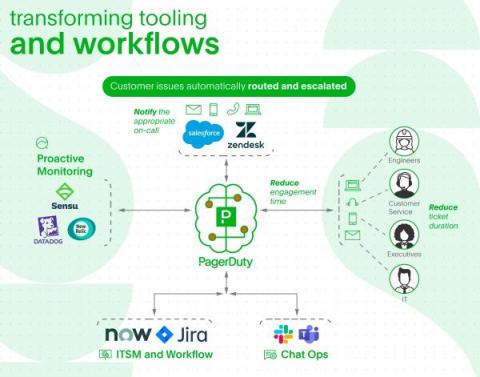
Intelligent Swarming vs. Tiered Support: How Customer Service Teams can use PagerDuty to Swarm Critical Issues

Most support organizations today adopt some form of the traditional tiered support model. It is one that is based on a process of escalations and customer handoffs. Under this model, customer issues get escalated through multiple levels of a support hierarchy, with three tiers being a common workflow.


Why Serverless? The Next Wave Of Cloud Cost Optimization

Traditionally, applications are developed and deployed on local servers managed by developers. This keeps the whole process under the control of one development team that is responsible for keeping the system running smoothly. With serverless computing, however, the server management and code execution within applications takes place remotely, under the control of the cloud service provider rather than an in-house development team.

The Importance of Observability for the SRE

The term Site Reliability Engineer (SRE) first appeared in Google in the early 2000s. In Google’s 2016 SRE Book, Benjamin Treynor Sloss wrote that, generally speaking, “an SRE team is responsible for the availability, latency, performance, efficiency, change management, monitoring, emergency response, and capacity planning of their service(s).” This means that the SRE teams at Google decide how a system should run in production as well as how to make it run that way.

Five Trends Driving Australia's Data Landscape in 2022

The last couple years have set new global benchmarks for the data and technology sector, putting companies that have considerably accelerated their digitisation processes in the front row. Our relationship with technology also changed immensely. One that has created new expectations by and for all stakeholders – from consumers to enterprise technology companies and governments.

5 Misconceptions About Cloud Cost Optimization Tools

Unless you are one of the 1% of enterprises that have zero workloads running in the publice cloud, you need a cloud cost optimization tool. Yes, you do. And if you have workloads running in multiple public clouds—which somewhere in the neighborhood of 85% of enterprises do—you really need a cloud cost optimization tool. If I’m preaching to the choir, feel free to skip to the end of this article where you’ll find a link to try Virtana Optimize for free.

Why Are IT Pros Hesitant to Deploy Windows 11?

A key aspect of my job is to speak to End-User Computing (EUC) professionals on a regular basis—analysts, customers, partners, etc.—to better understand their challenges and objectives. Unsurprisingly, one topic has been coming up a lot lately: Windows 11. Surprisingly, nobody wants to actually deploy it. Or, at least, not right now. Why? After countless discussions, 4 reasons were made clear for their reluctance with Windows 11: These are all valid points.

Crash Course in Crash Grouping

Supporting large applications with enormous crash volumes can be a real pain in the hindquarters. It is extraordinarily difficult for organizations to optimally dispatch engineering resources without excellent data and proper tooling. At BugSplat, we recently upgraded the tooling we provide to developers so that they can group related crashes and better target their support efforts, deliver more stable applications, and deliver more value to their customers.

Lindesberg Municipality Improves Network Reliability & Quality for its 5,500 Users w/ WhatsUp Gold

Lindesberg Municipality’s 5,500 simultaneous users were constantly losing connection with its network and IP Telephony systems, which led to a volume of support calls that was straining its IT department. It implemented WhatsUp Gold to monitor its connections and servers and study its access points. Lindesberg has moved from a network-centric to a service-centric installation, with 99.9% uptime, happier customers, and less support tickets.