Operations | Monitoring | ITSM | DevOps | Cloud

The latest News and Information on Containers, Kubernetes, Docker and related technologies.

The Case for Owning Your Infrastructure

Early technical decisions can help make or break a product. The effort to make the right decisions can be a great unifier between standout engineers and top notch executives At Cycle we've been obsessing over the nuances of infrastructure automation for years. So far, it's landed us on the G2 grid as a high performer in a category dominated by the goliaths of the cloud world.

Kubernetes vs Docker : A comprehensive comparison

If you’re new to the world of containers there are two words you would have certainly come across, but might not yet understand the difference between: Kubernetes and Docker. Although Kubernetes and Docker are somewhat different from each other, they also share some similarities. A container is a standard unit of software that packages the code along with the libraries and dependencies so that the application can run quickly, seamlessly and reliably from one environment to another.

We built the "Netlify for backend" that runs on your AWS account!

In 2020, my co-founders and I had this crazy idea of bringing a better Developer Experience on top of AWS. You know, the one that you can easily use with "the promise of the cloud" that any developer can take advantage of and deploy their next successful product in seconds. Somehow, the missing product of AWS 😅. This is where Netlify was an excellent source of inspiration. A nice Developer Experience, where deploying an application is as simple as pushing your code on Git.

GitOps your WordPress with ArgoCD, Crossplane, and Shipa

WordPress is a popular platform for editing and publishing content for the web. This tutorial will walk you through how to build out a WordPress deployment using Kubernetes, ArgoCD, Crossplane, and Shipa. WordPress consists of two major components: the WordPress PHP server and a database to store user information, posts, and site data. We will define these two components and store them in a Git repository.

Sponsored Post

Infrastructure monitoring using kube-prometheus operator

Prometheus has emerged as the de-facto open source standard for monitoring Kubernetes implementations. In this tutorial, Kristijan Mitevski shows how infrastructure monitoring can be done using kube-prometheus operator. The blog also covers how the Prometheus Alertmanager cluster can be used to route alerts to Slack using webhooks. In this tutorial by Squadcast, you will learn how to install and configure infrastructure monitoring for your Kubernetes cluster using the kube-prometheus operator, displaying metrics with Grafana, and configuring alerting with Alertmanager.

Using Containers for Microservices: Benefits and Challenges for your Organization

Using containers for microservices has gained a lot of popularity in the last decade or so. Developing the application through microservices across multiple containers results in the best of both worlds. It provides resilience as well as agility through scaling and improvements. Before we dwell on how containers and microservices form an ideal combination, let’s start with a basic understanding of microservices and containers.

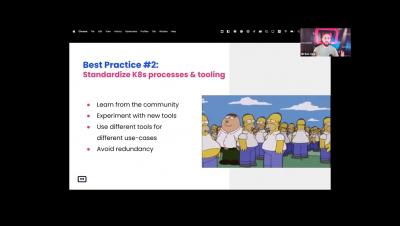
How Bitso Empowers Its Devs to Troubleshoot K8s Independently

More often than not, Kubernetes is behaving as it should: fast, agile and scalable. But what happens when K8s misbehaves? Do the responders have the right tools to deal with the situation? Or are they just part of an escalation chain that always leads to the same small group of experts? Meet Bitso, a billion-dollar company and the largest crypto platform in Latin America, which has mastered the shift-left approach and empowered its dev team to troubleshoot K8s independently.