Operations | Monitoring | ITSM | DevOps | Cloud

The latest News and Information on DevOps, CI/CD, Automation and related technologies.

Rancher 2.5 Embraces GitOps at Scale with Rancher Continuous Delivery

The ability of Kubernetes to easily deploy and manage containerized software has given organizations tremendous capabilities in their cloud services, with clusters multiplying into the hundreds or thousands and extending out to the edge for any number of purposes. But its growing popularity has also led to challenges in managing complexity in an environment that is conducive to cluster sprawl.

The JFrog Platform - End-to-end DevOps Solution

Manage your DevOps pipeline from a single pane of glass. The JFrog Platform provides a universal end-to-end solution that integrates with your ecosystem to orchestrate and optimize all key processes in your CI / CD pipeline. Deliver fearless updates from code to the edge in self-managed, on-prem, hybrid, and multi-cloud environments.

Image scanning for Google Cloud Build

In this article, you will learn how to add inline image scanning to a Google Cloud Build pipeline using the Sysdig Secure DevOps platform. We will show you how to create a basic workflow to build your container image, scan the image, and push it to a registry. We will also customize scanning policies to stop the build if a high-risk vulnerability is detected.

Redirect HTTP to HTTPS with HAProxy

Use the HAProxy load balancer to redirect users from HTTP to HTTPS automatically. For decades, our lives have become increasingly dependent on sending and receiving data from across the Internet. Now, with more people working, studying, and hanging with friends remotely, that trend is showing an uptick. Yet, adversaries seem to be grasping at that communication from every direction.

Getting Started with Continuous Integration

It is impossible to overestimate the importance of a strong development environment when scaling your team’s capacity. Nowadays, most organizations use Git, and one of the popular and successful development models used by many organizations is Gitflow. When making use of such models, continuous integration (CI) is key as it enables faster project delivery and offers reduced risk and expenses thanks to self-managed and easy-to-control dedicated teams.

Effective Alerting for a Server Monitoring

Every minute of server downtime can cost you serious revenue. 98% of organizations revealed that a single hour of downtime costs them over $100,000. The good news is that you can effectively prevent such losses with server monitoring software. Being a critical piece of your technical infrastructure, servers must be continuously tracked for their performance, and health. Efficient server monitoring lets you resolve issues before they become too critical.

Continuous Deployment explained in code

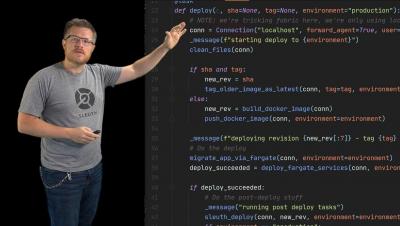
Don Brown, CTO/Co-founder of Sleuth and ex-Atlassian Architect, shows what Continuous Deployment is and how to we use it to build and deploy Sleuth, itself a deployment tracker. It steps through the CircleCI and Fabric configuration files and code that takes each commit to master and puts them through staging and production environments automatically.

Smart Cities: Cars, Roads & Mobility

This is the third blog post in a series on “Smart Cities and Urban Environments” and the implications for networks & telecoms. About 55% of the world’s population lives in urban areas; for developed OECD countries the figure is about 80%. Urbanisation is good for economic and even environmental reasons, but brings challenges for transport, roads and personal mobility*.

All Hands on Deck: P2P Distribution Combats Latency to Speed Delivery

With any huge task, more helpers make it go faster. That’s the solution large organizations increasingly seek for deploying large applications to hundreds of nodes. When others pitch in, many hands make light work. JFrog is pleased to introduce Peer-to-Peer (P2P) Distribution to help deliver content to huge K8s cluster runtime environments efficiently and at scale.

How to Reduce MTTR With PagerDuty and Puppet's Relay

DevOps and SRE teams are under intense pressure to reduce the mean time to recovery (MTTR) when resolving incidents. With the proliferation of cloud services and the increasing complexity of DevOps toolchains, engineers today need to not only learn how to use these services, but also troubleshoot them when an incident is raised at 2 a.m. The problem is, many incident response processes are still manual today—cobbling together runbooks and ad hoc scripts and orchestrating people to respond.