Operations | Monitoring | ITSM | DevOps | Cloud

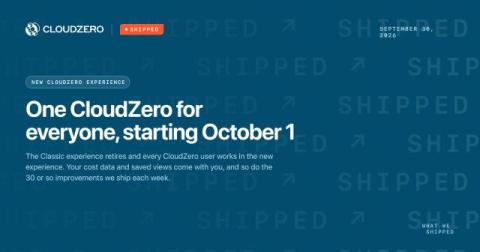
Shipped: One CloudZero for everyone, starting October 1

On June 3, we made the new CloudZero experience the default for every customer. Since then, we’ve shipped around 30 improvements a week: side-by-side period comparisons in Explorer, budgets you can create and edit right in the app, threshold alerts on dashboard tiles, and Monitors, which flags AI and cloud spend that moves outside its normal pattern and shows you what changed. Pages load 28 to 61% faster. JavaScript execution is 85% faster.

Auto-Generate Richer Azure Architecture Diagrams

Azure architecture diagrams go out of date fast, and management-plane data alone misses the runtime connections that matter most. In v5.4, diagrams move to their own Diagrams tab in Azure Documenter. Alongside the enhanced network and workload diagrams, there is a new Resource Visualizer diagram. Scope it by subscription and resource group, or write your own custom Azure Resource Graph query to define exactly which resources to include.

Change the Cloud Cost Conversation from Spend to Margin

"Our Azure bill went up 20% last month." Without context, finance only sees a rising cost. Unit economics gives them the full picture. Turbo360 lets you overlay business KPIs on your Azure spend. Track units like orders, active users, document views, or monthly recurring revenue alongside cost, and see your cost per unit month over month. Now the conversation becomes: "Orders went up 150% and our cost per order came down." That is a story about efficiency, not overspend.

IT Service Continuity Management: How to Build an ITSCM Plan

Most IT teams have a recovery plan somewhere. It was written for a disruption that has not happened yet, and tested less often than anyone admits. The gap rarely sits in the technology. Nobody agreed which services come back first, or how fast. There was time to settle that calmly, and it went unused. IT service continuity management is the ITIL practice that settles those questions in advance. In this blog, you will: By the end you will know what belongs in an ITSCM plan and who has to agree to it.

How IT Infrastructure Management Keeps Services Reliable and Costs Predictable

When a business application slows down, how fast can your organization trace the cause to a server, a network link, storage or a cloud instance? Often it comes down to who's on call that day, since asset, observability and change data are scattered across separate systems. Engineers then check each tool one at a time while customers wait and the cost of the outage grows. IT infrastructure management solves this by keeping asset records, health data and change history in order before an incident starts.

Database change management on Databricks: migrations, environments, and AI-generated change

You wouldn’t ship untested SQL Server database changes – Why is Databricks different? Databricks is where the data estate is growing, and increasingly where AI workloads run and generate change. But schema change there still happens the hard way: views and stored procedures managed through manually versioned scripts, drift between workspaces discovered when a deployment fails, and no reliable record of what changed, when, where, or why. As AI raises the volume and speed of schema change, these gaps widen.

This AI agent finds your app's bottlenecks and suggests the fix

Most teams collect the profiles and traffic data that explain a slowdown. Almost nobody has time to read it before users notice. In this Product Highlights conversation, Sylvain Guittard, Senior Director of Product at Upsun who leads the team behind the Upsun console and CLI, breaks down the Upsun Cloud Performance Agent, the first background agent running on Upsun Cloud. His take: "We monitor everything, we feed that into an agent, and the agent will be capable of finding what the bottlenecks are in your application. And on top of it, it gives you a patch, or a way to fix it." We get into.

Watch this AI agent find and fix performance bottlenecks

Anyone can claim an AI agent will fix your performance problems. This demo shows exactly what it looks at and what it hands back. In this Product Highlights conversation, Sylvain Guittard, Senior Director of Product at Upsun who leads the team behind the Upsun console and CLI, runs the Upsun Cloud Performance Agent live on a demo project. His take: "You have a patch that is already available, and a recommendation, so you can see if it fits or not to your context." We get into.

Realtime transaction fraud detection - with an LLM?

Conversational AI with a chatbot is great for drafting emails or debugging code, but it’s less ideal for real-time application middleware. If you’re trying to inspect a financial transaction for potential fraud in the middle of a checkout loop, you don’t need an LLM to write you an essay about why a credit card transaction looks suspicious – you just need a probability score, and you need it as fast as possible.

Right-size your analytics stack with Aiven for ClickHouse

TL;DR If most of your Snowflake or Databricks spend goes to dashboards and reports, you are paying for a platform built for much bigger problems. Aiven for ClickHouse runs those workloads on a fixed plan, so adding dashboard users does not add to your compute bill. Native integrations with PostgreSQL and Apache Kafka also replace most of the ingestion and orchestration tools around your current platform. Move one dashboard at a time, and keep Snowflake or Databricks for work such as model training.