

Operations | Monitoring | ITSM | DevOps | Cloud

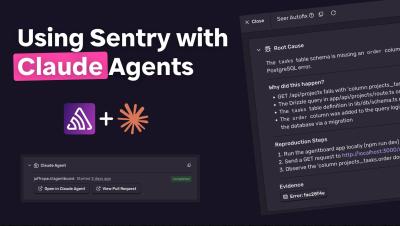
Sentry + Claude Agents: Automatic Bug Fixes from Root Cause to PR

Seer, Sentry's AI debugger, automatically analyzes your issues and finds the root cause. Now you can pass that analysis directly to a Claude agent - a managed agent session in the Claude Console at platform.claude.com. Once it's done, a link to the branch appears in Sentry so you can review and merge the PR. This video walks through how the integration works and how to set it up in under two minutes.

The Claude Bill is Too Damn High #speedscale #claude #aiagents #aicoding #devops #llms

Stop overpaying for AI reasoning by trading expensive GPU cycles for efficient, deterministic testing. This video explores how tools like linters and traffic replay can complement Claude, helping you fix bugs more accurately while cutting token usage by up to 50%. Visit: speedscale.com to learn more.

How is Agentic AI fundamentally different from earlier automation?

Autonomous operations has been the goal for years. But most “automation” never got us there—it just helped teams keep up. Now that’s changing. Agentic AI introduces a fundamentally different model:– Purpose-built agents, not static workflows– Real-time decisioning, not predefined rules– Collaboration across agents, not isolated tasks Instead of automating steps, agentic AI enables systems to **reason, adapt, and act**—at a speed and scale humans simply can’t match. That’s what turns autonomous operations from a long-standing ambition into something actually achievable.

How Diffusion Transformer Models Power Hyper-Realistic AI Avatar Videos

The AI avatar videos from a year ago still had a tell. The mouth movement was a little off, the facial expressions were a bit stiff. It was a quality that made it obvious that you were looking at a digital human and not a real one. The uncanny valley issue was not a small aesthetic problem, it was the only thing that stopped the practical adoption of anything other than novelty use cases.

Run Local LLMs on Mac to Cut Claude Costs

Part of the motivation for this post is how cloud API economics are shifting: Anthropic is moving large enterprise customers toward per-token, usage-based billing (unbundled from flat seat fees), which makes “always call the API” a moving cost line for teams at scale. A hybrid or local layer is one way to keep spend bounded while you still use premium models where they matter.

When agents orchestrate agents, who's watching?

You used to monitor services. Then you started monitoring AI calls inside services. Now your AI agent is spinning up other AI agents to complete tasks. Your old monitoring instincts need to evolve. This isn't hypothetical. Agentic architectures are already in production. Coding agents are calling search agents; orchestrators are spawning specialized sub-agents for retrieval, planning, and execution. Teams are shipping these systems faster than they're figuring out how to watch them.

What does using AI for post-mortems actually mean?

Everyone is using AI to help with post-mortems now. The pitch is obvious: post-mortems are time-consuming, the blank page is brutal, and AI is very good at producing structured, confident-sounding documents quickly. We're not here to push back on that. We've built AI into our own post-mortem experience, pulling your Slack thread, timeline, PRs, and custom fields together and giving your team a meaningful starting point in seconds. We think that's genuinely valuable, and the teams using it agree.

How it feels to run an incident with Investigations

We've been building the broader incident.io platform for several years now, and one thing we've learned is that UX matters more here than almost anywhere else. When an incident fires, there's no room for poorly designed interfaces or fumbling through features you haven't touched in a while — every second of the incident response lifecycle counts. The product has to be ergonomic: easy to pick up, easy to navigate, with the right things at your fingertips at exactly the right moment.