IT analytics in 90 seconds: Strategize an efficient IT budget
Beat the stress of financial budgeting with Analytics Plus' AI-enabled automation capabilities.


Is Telegraf too big for your device? Too many plugins in one binary getting you down? Let me introduce you to the Telegraf custom builder – the new tool for reducing Telegraf’s overall memory and disk footprint. In this blog, we will discuss the “what, why, when” and also how to use the new custom builder.
According to the old adage, life’s a journey not a destination. The same can be said for software. It’s unlikely that any developer would ever say that something they built was truly done. There are always bugs to squash, features to add, and updates to implement. As a company intensely focused on time and the context of time, it comes as little surprise that these themes played a significant role in Paul Dix’s presentation for InfluxDays.
This week at InfluxDays we announced that Flux 1.0 is coming soon. Version 1.0 of Flux lang is a commitment to no longer make breaking changes to the Flux language. Importantly, today’s Flux scripts will work on Flux 1.0, and no breaking changes will be introduced between now and the release of Flux 1.0. Along with version 1.0, we have some features we are also releasing soon. Here are the features we have coming and a short explanation of why you might want to leverage them.
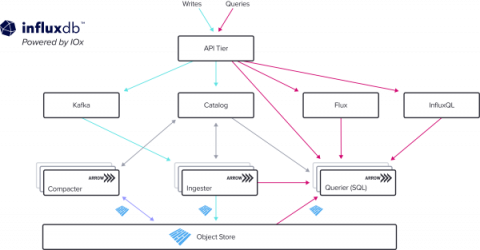
Last week InfluxData announced IOx, the new time series engine for InfluxDB. We’ve revisited the core of our database to achieve big things with the underlying technology. Users can expect higher performance and more options for querying data. Here’s a quick intro to some of the most exciting things coming with InfluxDB IOx.
SAN FRANCISCO, November 2, 2022 – Today, InfluxData, creator of the leading time series platform InfluxDB, announced significant product enhancements at InfluxDays 2022, its annual developer and community event. New features including InfluxDB Script Editor, Telegraf Custom Builder, and Flux 1.0 support developers working with time series data, allowing them to do more with less code.
The InfluxDB platform has evolved a lot over the past decade. But with every innovation we’ve added to the platform, the focus behind our efforts has remained the same: Build cool stuff for people who build cool stuff. What we mean by this is we want to make it incredibly easy for users to build valuable applications with their time series data. We do that by offering a wide range of tools, features, and resources that meet builders on their terms.