Operations | Monitoring | ITSM | DevOps | Cloud

The latest News and Information on API Development, Management, Monitoring, and related technologies.

The Infrastructure Puzzle: How AI-Enabled Event Management Software Powers Complex Event Programs

When registration, attendee data, check-in, communications, and reporting stop working in concert, complex programs break. A connected online event management software setup gives teams one operating layer, not yet another stack of tools that complicates work.


Load Test PostgreSQL Instantly using Production Recordings

The first PostgreSQL post ran on a laptop: a demo app, a Docker container, and the proxymock CLI. That is the fastest way to see the idea. It is also not where your database problems live. Your real query mix lives in the cluster, where a Java service with a connection pool, an ORM and a schema migration tool sends the statements nobody wrote by hand. This post deploys an open source banking app to Kubernetes and records the queries one of its services sends to PostgreSQL.

FastAPI 0.142 Turns On OpenTelemetry by Default. Here's What It Records.

FastAPI 0.142.0 ships with OpenTelemetry built in. Install fastapi, set one environment variable, and every request produces a trace, metrics, and error logs. No middleware, no instrumentation package, no code. That’s a big change for a framework most Python teams instrument by hand. It’s also easy to misread. The defaults record more than some teams expect in one place, and less than others assume in another. Here’s what you actually get.

Judgment, not generation: rebuilding our AI API Classifier on Jev

Rebuild AI API classification with Jev to cut costs, reduce latency, improve calibration, and make production decisions more efficient without sacrificing accuracy. Replacing the judgment step in a production classification pipeline with a purpose-built decision model changes the economics of the problem entirely.

Prove Your SLAs: How Yext Ties Synthetic Monitoring to SLOs with Checkly (Live-Webinar)

Yext uses synthetic monitoring to prove and meet SLAs, by tying Checkly checks directly to SLOs and user-facing SLIs. Stefan (Developer Relations), Braxton (Solutions), and Shikhar (Engineering Productivity at Yext) cover the SLA/SLO/SLI basics, the math behind "all these nines", and how Yext turns those targets into concrete checks with monitoring as code.

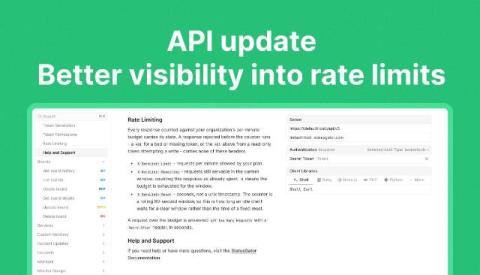
API update: Better visibility into rate limits

We’ve updated the StatusGator API v3 to help you see how many requests your integration can make and handle rate limits more smoothly. Responses that count toward your organization’s per-minute limit now include three headers: If a request exceeds your limit, the API returns 429 Too Many Requests and a Retry-After header telling your integration how many seconds to wait before trying again.

Starlette 1.7.0 Brings Native Tracing and Smarter Route Naming

If you’re running FastAPI, you’re running Starlette underneath it, whether you think about it or not. At Scout, we spend a lot of time thinking about what happens at that ASGI layer, since that’s exactly where our Python agent hooks in to give you request-level visibility. Starlette 1.7.0 just landed, and it’s a release worth reading closely if you care about tracing, routing, or just keeping your app running on a supported dependency chain.