Operations | Monitoring | ITSM | DevOps | Cloud

The latest News and Information on Cost Management and related technologies.

Why Cloud Cost Optimization for Engineers Fails

Learn why cloud cost optimization for engineers fails and how to fix it with developer-centric FinOps practices. See how Harness helps. Engineers often ignore cloud costs due to a lack of visibility, context, and ownership in their daily workflows. By shifting cost governance left and integrating real-time cost insights into CI/CD pipelines, teams build lasting cost accountability.
Best LLM inference providers 2026: 16+ on cost per outcome

An LLM inference provider hosts open-weight models like Llama, DeepSeek, and Qwen behind a pay-per-token API, handling GPUs, scaling, and serving for you. The same Llama 3.3 70B model ranges from $0.10 to $1.04 per million input tokens depending on who serves it, so provider choice is a pricing decision. Top picks as of September 2026: Groq and Cerebras for speed, DeepInfra for price, Together and Fireworks for breadth, Baseten for custom models.

Build vs. buy: should you build your own AI cost management tooling?

Build when the problem is narrow (one provider, one team, simple attribution) and the tooling is strategically yours to own. Buy when AI spend spans providers, arrives untagged, and needs unit costs finance will trust, because that build is a multi-quarter platform project with a permanent maintenance tail. Price both paths in engineer-years before deciding. CloudZero sells the “buy” side.

Perplexity pricing in 2026: Free vs. Pro vs. Max, and who should pay

Perplexity pricing runs $0 for Free, $20 a month for Pro, and $200 a month for Max, with enterprise seats listed from $40 per user. Pro fits most people who search for work daily. Max exists for heavy automation. The prices are verified against Perplexity's live plans page as of September 2026. When Perplexity published a customer quote on its own pricing page, it chose an unusual one.

Kling AI pricing in 2026: plans, credit costs, API packages, and the spend no invoice shows

Kling AI pricing runs from a free tier of 66 daily credits to a reported $180 per month, with annual billing about 34% cheaper. Kling 3.0 bills per second: 6 to 12 credits for standard resolutions and 30 for native 4K. The API sells separate prepaid packages from $9.80 to $7,560.

ElevenLabs pricing in 2026: plans, credits, and agent costs

ElevenLabs pricing runs from a free plan to $990 per month across six published tiers, with custom Enterprise above that. Plans meter usage in credits, where one credit roughly equals one character of speech. Voice agents cost $0.08 per minute on every tier, plus separate LLM and telephony charges. The AI agency PxlPeak published its own ElevenLabs invoice: $303 for January 2026, covering voice content for six clients, IVR systems for two, and live voice agents for three.

Token-based pricing: how AI usage billing works (2026)

Token-based pricing charges for AI by the volume of text a model processes, metered separately for input tokens (what you send) and output tokens (what the model returns). As of 2026, OpenAI, Anthropic, and Google all bill their APIs this way, and the model is spreading into enterprise chat products. Bills scale with usage rather than seats.

Manage Cursor costs with Datadog Cloud Cost Management

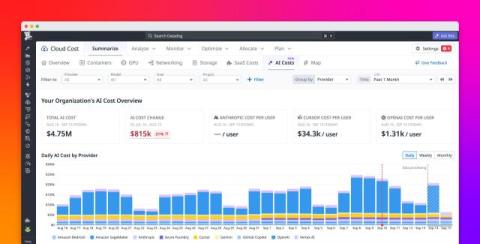
AI coding tools such as Cursor are becoming a significant source of engineering spend. But Cursor costs can be difficult for FinOps teams to manage. Cursor’s usage data alone doesn’t tell you how costs break down across users and models, and fixed-threshold alerts may not catch an unusual cost spike if spend remains below the threshold. Datadog Cloud Cost Management (CCM) brings Cursor costs into the same place where you monitor cloud, SaaS, and other AI spend.

150+ AI statistics for 2026: spend, cost, and AI ROI

Worldwide AI spending will reach $2.59 trillion in 2026, up 47% from 2025, according to Gartner. Yet only 37% of organizations report any earnings impact from AI, McKinsey finds. These AI statistics cover what companies spend, what AI costs to run, and the ROI they're actually getting. That gap between the two headline numbers is the story of AI in 2026.