Operations | Monitoring | ITSM | DevOps | Cloud

The latest News and Information on DevOps, CI/CD, Automation and related technologies.

Migrating On-Premises File Shares to Azure File Storage

As businesses grow, so does their need for scalable and secure data storage. For many companies, on-premises file shares have long been the preferred method of storing and sharing data. However, with the advent of cloud computing, more and more businesses are turning to cloud-based storage solutions like Azure File Storage. In this article, we will explore the challenges and solutions involved in migrating on-premises file shares to Azure File Storage.

What is real-time Linux? Part I

Welcome to this three-part blog series on real-time Linux. Throughout the series, we will assess the key features of a real-time system. We will understand how a real-time capable Linux kernel differs from mainline, and touch upon the performance trade-offs you should consider when choosing real-time versus a low-latency kernel, for instance.

Harnessing the potential of 5G with Kubernetes

5G is the fifth generation of wireless technology which is transforming the way we connect and communicate. With data transfer speeds up to 100 times faster than 4G, 5G technology enables faster download and upload times, lower latency and a higher number of connected devices. Additionally, 5G networks will support a wider range of frequencies, including high and low bands, which will ensure wider coverage and greater reliability.

Get your team to adopt DORA metrics when you're already on board

Need help getting your teams to adopt DORA metrics? Join this live stream on Thursday, February 23 at 9 a.m. PT to learn how. Sleuth TV Live is back for season 2! It's a common reality: You're already on board with DORA metrics and ready to run with them, but now you need to get your teams to adopt DORA metrics. How? We'll share 5 ways we use DORA metrics at Sleuth to shed light on the possibilities for your own team.

Autonomously optimize AWS Lambda deployments with Sedai and Datadog

In dynamic production environments, unpredictable traffic loads and frequent code changes can make it difficult for organizations to consistently optimize their cloud infrastructure, resulting in application performance issues, latency, and wasted cloud spend. Teams that manage large-scale cloud infrastructure deployments are often forced to tune their workloads’ configurations using a complicated mesh of script jobs—or worse, manual remediation by on-call engineers prompted by alerts.

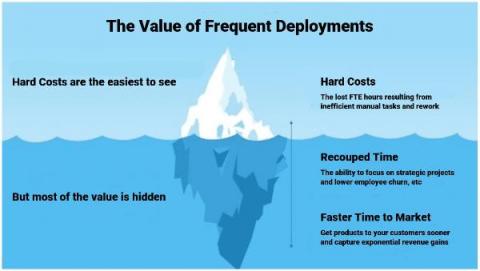
The business value of frequent deployments: Faster time to market

In this series, we’ve been exploring the different layers of business value you can gain from deploying software more frequently. We’ve already looked at the hard costs you can save, and the valuable developer time you can recoup. But that’s not the end of the story. Not by far. Picture an iceberg. The top, the visible part, is those hard costs. Just beneath the surface is that time that can be gained by redeploying wasted time to projects that matter.

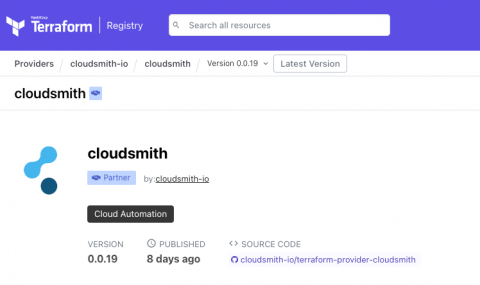
Terraform Provider Enhancements

The team at Cloudsmith is excited to build upon our past support and integration with Hashicorp Terraform to include managing teams, update repository settings, and manage services (API Keys) via the Terraform Provider Module. The team at Cloudsmith is excited to build upon our past support and integration with Hashicorp Terraform to include managing teams, update repository settings, and manage services (API Keys) via the Terraform Provider Module.

10 Ways to Improve MDF/IDF Closet Management

Main Distribution Frames (MDF) and Intermediate Distribution Frames (IDF) are integral components of modern data communication networks. Buildings or campus facilities have one or more MDFs which are the demarcation points where public or private telecommunication networks interconnect with the internal network. The MDF then connects to any number of IDFs in the building, and the devices in those IDFs connect to end devices such as workstations.