Operations | Monitoring | ITSM | DevOps | Cloud

Grafana OnCall: Use the new bi-directional ServiceNow integration for seamless alert flows

Every moment counts when you’re managing incidents that can affect your services and customers. That’s why we’re excited to introduce a new bi-directional integration between Grafana OnCall and ServiceNow, a popular platform many large organizations rely on to help manage their incidents.

Serverless observability: How to monitor Google Cloud Run with OpenTelemetry and Grafana Cloud

OpenTelemetry has emerged as the go-to open source solution for collecting telemetry data, including traces, metrics, and logs. What’s especially unique about the project is its focus on breaking free from the reliance on proprietary code to offer users greater control and flexibility. As a senior solutions engineer here at Grafana Labs, I’ve spent a lot of time exploring OpenTelemetry, including in my spare time.

How to visualize Amazon CloudWatch metrics in Grafana

In the wide world of observability, you have many options for visualizing metrics collected by Amazon CloudWatch. And because of that, you’re often left making lots of decisions — about cost, configurations, flexibility, and more. At Grafana Labs, we stick to our “big tent” philosophy, which means we don’t force you into a decision or even tell you that you have to bring your CloudWatch metrics to Grafana Cloud.

How to use Grafana Beyla in Grafana Alloy for eBPF-based auto-instrumentation

At GrafanaCON last month, we announced Grafana Alloy, our open source distribution of the OpenTelemetry Collector. Alloy is a telemetry collector that is 100% OTLP compatible and offers native pipelines for OpenTelemetry and Prometheus telemetry formats, supporting metrics, logs, traces, and profiles. Today, we are excited to share that Grafana Beyla is now available in Grafana Alloy as the default eBPF-based application auto-instrumentation solution.

Grafana OnCall: Connect to Discord, Mattermost, and more with webhooks

One important consideration when adopting a tool is whether it can integrate with your existing workflows and services. Each scenario can be highly specific, which is why it’s important to look for tools that have a public API or customizable webhooks. Last year, Grafana OnCall expanded its webhook support to allow for more complex setups, offering greater flexibility to interact with other services during alert group events.

Grafana Cloud updates: revamped Synthetic Monitoring, improvements to Kubernetes Monitoring, and more

We consistently release helpful updates and fun features in Grafana Cloud, our fully managed observability platform powered by the open source Grafana LGTM Stack (Loki for logs, Grafana for visualization, Tempo for traces, and Mimir for metrics). In case you missed it, here’s a roundup of the latest and greatest updates for Grafana Cloud this month. You can also read about all the features we add to Grafana Cloud in our What’s New in Grafana Cloud documentation.

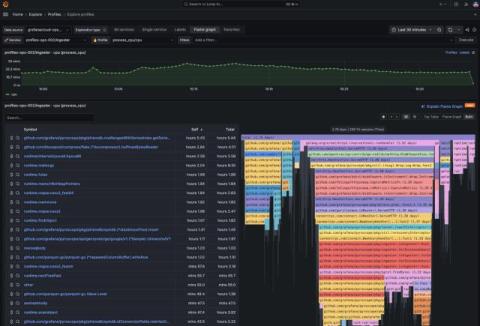
AI-powered insights for continuous profiling: introducing Flame graph AI in Grafana Cloud

Like many in the observability space, we see a lot of potential in harnessing AI to enhance the developer experience. As we continue to evolve and expand our observability platform, we strive to develop features that not only solve complex problems, but make it easier to access and derive value from tools like Grafana Pyroscope.

How to explore metrics without PromQL queries in Grafana

At GrafanaCON 2024, Grafana founder Torkel Ödegaard introduced Grafana 11, which has a feature set that aligns with the same goals we’ve had since the OSS project launched in 2013. “The core mission of Grafana that we’ve had from the start is to make observability easy and powerful through good UX design, a focus on ease of use, and user flexibility and freedom,” Torkel said.

Grafana transformations: 10 new ways to get more out of your data

One of the superpowers of Grafana is the ability to bring all of your data into a single platform thanks to our rich catalog of data sources. Oftentimes you will want to visualize information from disparate data sources together in a single dashboard or panel. Or you might want to refine data returned from queries without altering the original data source. Or you may need to modify data due to limitations of a query language that stops you from getting the required formatting.

Grafana Alerting: new tools to resolve incidents faster and avoid alert fatigue

The maturity of your alerting strategy has a direct impact on the reliability of your infrastructure and your applications. It can also have a big impact on engineering productivity. So whether you’re talking about resolving incidents faster or avoiding alerting fatigue, alerting should always be front and center.