Operations | Monitoring | ITSM | DevOps | Cloud

Open source log monitoring: The concise guide to Grafana Loki

Five years ago today, Grafana Loki was introduced to the world on the KubeconNA 2018 stage when David Kaltschmidt, now a Senior Director of Engineering at Grafana Labs, clicked the button to make the Loki repo public live in front of the sold-out crowd. At the time, Loki was a prototype: We bolted together Grafana as a UI, Cortex internals, and Prometheus labels to find out if there was a need for a new open source tool to manage logs.

Grafana Alerting: How to monitor alerts for better alert management

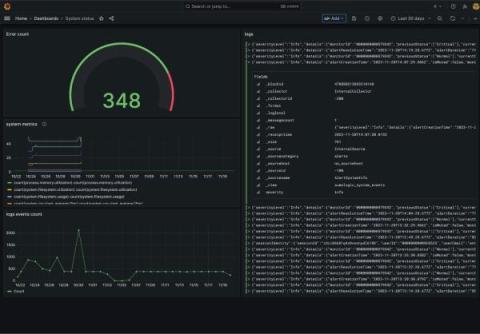
With the release of Grafana 10.2, we made a number of enhancements to Grafana Alerting. These updates included the rollout of Insights, a new section of the Grafana Alerting home page. Available now to all Grafana Cloud users, Insights offers valuable information, such as statistics on alert rules and notifications, to help you monitor alerting data and quickly analyze alert performance.

Traces to metrics: Ad hoc RED metrics in Grafana Tempo with 'Aggregate by'

In observability, finding the root cause of a problem is sometimes likened to finding a needle in a haystack. Considering that the problem might be visible in only a tiny fraction of millions or billions of individual traces, the task of reviewing enough traces to find the right one is daunting and often ends in failure.

The case for Kubernetes resource limits: predictability vs. efficiency

This blog post by Grafana Labs Senior Software Engineer Milan Plžík was originally published on the Kubernetes.io blog on Nov. 16, 2023. There’s been quite a lot of posts suggesting that not using Kubernetes resource limits might be a fairly useful thing (for example, For the Love of God, Stop Using CPU Limits on Kubernetes or Kubernetes: Make your services faster by removing CPU limits ).

'The Story of Grafana' documentary: Celebrating OSS, community, and innovation

On Dec. 5, 2013, Torkel Ödegaard made the first commit in GitHub for a personal project that would become Grafana. “It’s hard to believe it’s been 10 years since Torkel launched Grafana, growing from a small man with a big dream to becoming the most popular data visualization software in the world,” says Grafana Labs co-founder and CEO Raj Dutt. “The Story of Grafana” chronicles that meteoric journey.

Monitoring Microsoft Windows with Grafana Cloud: new updates

Windows is widely used by developers, businesses, and individuals alike. Renowned for its adaptability, security, and reliability, the operating system is a preferred choice for servers, desktops, and embedded devices. It also holds a significant presence in the cloud, serving as the foundation for numerous major websites and applications.

Log management with Grafana Cloud: 4 observability experts share their move from OSS to Grafana Cloud Logs

While we built Grafana Loki as an open source log aggregation system that is cost effective and easy to operate, let’s face it: sometimes there is no time or bandwidth to mess around with self-managing and self-hosting. Luckily there’s the fully managed Grafana Cloud observability stack for log management. “Grafana Cloud is a no-BS platform. The engineering costs of hosting it ourselves would be much higher," says Jameel Al-Aziz, a software architect at Paradigm.

Observability with Grafana Cloud: Explore the latest and greatest features

Grafana Cloud constantly evolves to include new, cutting-edge features for end-to-end observability. In fact, just last month at ObservabilityCON 2023, we made a number of updates to our fully managed observability platform, including the general availability of Grafana Cloud Application Observability, Grafana SLO, and Adaptive Metrics.

Grafana Agent v0.38 release: new OpenTelemetry components, configuration improvements, and more

Grafana Agent v0.38 has hit the digital shelves just before the holiday season! 🧑‍🎄 The elves over at Grafana Labs have been quietly working on Grafana Agent, with more than 50 updates for all SREs and developers to use — no matter if you’re on the naughty or nice list. This includes new features, improvements, bug fixes, and significant ease-of-use changes.

How to calculate the difference of a value over time with InfluxDB and Grafana

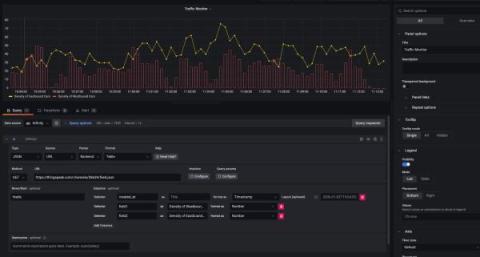
Learning about the past helps us understand the present, and even predict the future. So, whether you are monitoring CPU usage or how long your IoT device was powered on and then off, at some point, you might want to know the difference of a value over time. InfluxDB is an open source database for storing and retrieving time series data. Thanks to its own query languages — flux and InfluxQL — it provides different and powerful ways to analyze data.