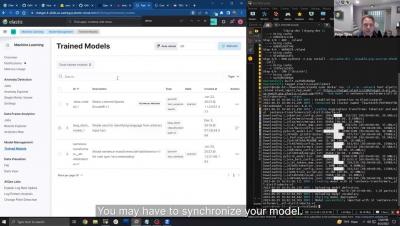
ChatGPT and Elasticsearch: OpenAI meets private data setup walkthrough
Follow along as Global Solutions Architect Peter Titov walks you through connecting Elasticsearch to OpenAI’s LLM for Retrieval Augmented Generation (RAG).


It’s been about 8 months since we first launched Cribl Search. For our early adopters, it’s been a game changer, and with each monthly release, we continue to innovate — expanding access to new datasets and adding new functionalities. If Crib Search is new to you, here is a quick recap. Cribl Search flips the observability data search paradigm on its head. You no longer have to collect, ingest, and index your data before you can search it.
Elastic Search 8.9 introduces hybrid search with Reciprocal Rank Fusion (RRF) to combine vector, keyword, and semantic techniques for better results. This release also brings performance improvements in vector search and ingestion with response times that are up to 30%+ faster. Users also have more ingestion options with the new SharePoint Online connector, which includes document-level security.
The term index is quite overloaded in the tech world. If you asked most developers what an index is, they might tell you it commonly refers to a data structure in a relational database (RDBMS) that is associated with a table, which improves the speed of data retrieval operations. But what is an Elasticsearch® index?
In Elasticsearch, an index is a logical container or namespace that holds a collection of documents that are related in some way. It is the primary unit for organizing and storing data. Indices in Elasticsearch serve as containers for organizing and managing data, enabling efficient search and retrieval operations. Understanding the concept of indices is crucial for effective data organization and utilization in Elasticsearch-based applications.
In this guide, we will compare two of the leading data visualization tools based upon open-source software that are available for use for metrics, traces and log analysis. To allow new users to know exactly which solution may be best suited to their needs, we wanted to explore in more depth a comparison between OpenSearch Dashboards and Kibana across various aspects in our latest guide covering the differences between leading open-source software.
Are you interested to learn about the characteristics of Elasticsearch for vector search and what the design looks like? As always, design decisions come with pros and cons. This blog aims to break down how we chose to build vector search in Elasticsearch.
In this tutorial, we will guide you through the process of migrating from Elasticsearch to OpenSearch. OpenSearch is aan open-source search and analytics suite that is compatible with Elasticsearch. There are several reasons why people choose to migrate, such as taking advantage of new features or differences in governance. In the following sections, we will discuss version compatibility considerations, and guide you through the migration process.