Operations | Monitoring | ITSM | DevOps | Cloud

Document the Process, Not the Kernel Version

When people say "document everything," they don't mean literally everything — they mean document what matters. Nobody needs to know the exact kernel version on a server build years from now. What they need is the process: how to get there again, step by step. Watch the full IT Leadership Lab session — linked above.
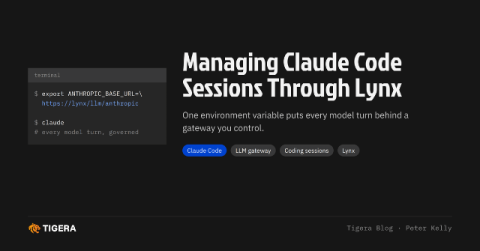
Managing Claude Code Sessions Through Lynx

At Tigera, we spend a lot of time thinking about agent security: identity, policy, runtime controls, and the record left behind after an agent acts. Coding agents create an interesting problem because, in most organizations, they didn’t arrive through the front door. Few companies ran a platform evaluation and rolled Claude Code out to 500 developers. Developers installed it themselves.

What is Interactive Application Security Testing (IAST)?

Interactive Application Security Testing (IAST) finds vulnerabilities in running applications by monitoring code from the inside. Learn how it works and where it fits. Interactive Application Security Testing (IAST) is a method for finding security vulnerabilities in an application while it's running, by instrumenting the code and observing how it behaves during normal use or testing.

Why Engineers Ignore Cloud Cost Optimization & Fixes

Learn why engineers ignore cloud cost optimization and how to build a culture of FinOps governance. See how Harness helps. Engineers often overlook cloud costs due to lack of visibility, fragmented tooling, and competing delivery priorities. Organizations can fix this by embedding FinOps guardrails into developer workflows and providing real-time cost feedback during build cycles.

SAST vs SCA vs DAST vs IAST: choosing the right scan for the right stage

SAST vs SCA vs DAST vs IAST: a clear breakdown of what each scan finds, when to run it, and how to combine them across your SDLC. Most AppSec teams don't run one type of scan - they run several, at different points in the pipeline, because no single tool sees the whole picture. This article breaks down SAST vs SCA vs DAST vs IAST: what each one actually tests, where it fits in the software development lifecycle (SDLC), and how to combine them without duplicating effort or drowning developers in findings.

One Cloud, Every Environment: The New Civo Dashboard | Civo Navigate London

Your infrastructure lives everywhere. Your view of it shouldn't. Civo CTO Dinesh Majrekar gives the first look at the new Civo dashboard. It's built around one idea: however many regions, clusters or environments you run, managing them should feel like one cloud. Civo makes complexity a thing of the past.

AI in IT Operations: How to Build Trust, Automate Smarter & Prepare for Autonomous IT

What does it take to make AI and automation actually work in enterprise IT? In this episode of Agents of IT, Resolve’s Zach Austin sits down with Nick Dimmock, Co-Founder and CEO of TechWorks, to discuss how IT automation is evolving, why trusted data matters, and what organizations need to build before AI can deliver meaningful business outcomes.

How to Use Megaport Storage as a Veeam Backup Target

Learn how to use Megaport Storage as an S3-compatible Veeam backup target for scalable, private, offsite backup storage. Table of Contents A backup is only useful if it can be retrieved when needed. Where backups are stored determines how well they’re protected from incidents at the primary site, how long recovery transfers take, and what it costs to bring the data back.

Every 404 in Your Rails App Might Be Allocating 13 MB

A bot requests /wp-login.php on your Rails app. Rails can’t route it, raises ActionController::RoutingError, and returns a 404. That should cost almost nothing. On a Rails 8.1 app with a few thousand compiled templates, it can cost 13 MB of allocations and 27 ms of CPU. A detailed report on rails/rails#58887 traces the cost to one method, ActionDispatch::ExceptionWrapper#build_backtrace.