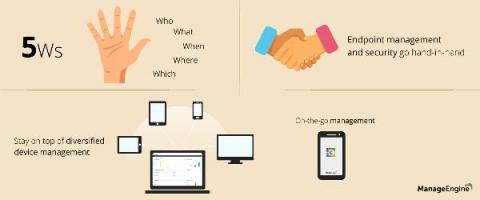
The continuous evolution and growth of the endpoint devices in enterprises makes network security management a primary concern for IT departments. As a sysadmin, you strive to ensure the safety and security of every device in your network. You are on a constant lookout for vulnerabilities and issues that might disturb the shield that protects your enterprise devices. With dynamically changing trends and technologies, it’s easy to miss details that might compromise your network’s armor.
Our hearts might skip a beat every time we put our hands in our pocket and can’t find our mobile phone, and we’re filled with dread at the thought of losing the device that contains our personal photos and the corporate data saved on it. But just misplacing a device is not how we put corporate data at risk; small actions in our day-to-day lives can have a major impact on the safety of the corporate data on our devices.
Addressing Wi-Fi issues can be challenging Tracking the availability, speed, and performance of a large number of systems, servers, VMs, routers, access points, firewalls, interfaces, and WAN links, plus monitoring their health is not a simple task. Tackling angry emails from employees about Wi-Fi running slowly, or it taking a lifetime to download a simple setup file or load a business-critical application, can hamper productivity.
In this four-part series, we explore hypothetical cyberattacks inspired by real-life events in four different industries: healthcare, finance, manufacturing, and education. We’ll take a look at unforeseen security attack scenarios, and discover how user and entity behavior analytics (UEBA) can be leveraged to safeguard organizations. In this second post of the series, we’ll examine cyberattacks that threaten the financial sector.
Halloween is perhaps the one night of the year where ghosts and ghouls roam freely on the streets. In reality, these are all just harmless children in costume; however, as you enter Halloween Cyber Street, you’ll come to find there are real threats lying in wait for an opportunity to strike. On Halloween Cyber Street, there are eight houses, each providing a webinar offering solutions on how you can protect yourself against different cyberthreats.
A critical vulnerability in sudo has been disclosed, that when exploited, enables users to bypass security restrictions and execute commands as the root user. This security flaw has to be swiftly remediated as sudo is one of the most integral and commonly used functionalities in Linux operating systems.
We’re proud to announce the latest feature in ServiceDesk Plus Cloud: IT Release Management. This new capability helps you build, test, and deliver IT software releases with minimal risks and greater transparency.
The past few months have seen both Android and iOS fall prey to various security attacks, with more malware attacks and exploits being uncovered on a daily basis. First, let’s look at the newest zero-day Android vulnerability. This vulnerability leverages the ”use-after-free” memory flaw to wreak havoc on mobile devices. In layperson terms, the use-after-free flaw allows access to memory recently freed (after performing some operation) to execute malicious code.