Operations | Monitoring | ITSM | DevOps | Cloud

Tech in the Forest: Driving Transparency in Wood Supply Chains

Wood supply chains are moving into a digital age. New tools help people see exactly where logs come from and where they go. The shift makes the entire process more open for everyone. Seeing every step of the journey builds trust. It keeps businesses honest and helps forests stay healthy for the long term. Changes are making a big impact on how we think about wood.
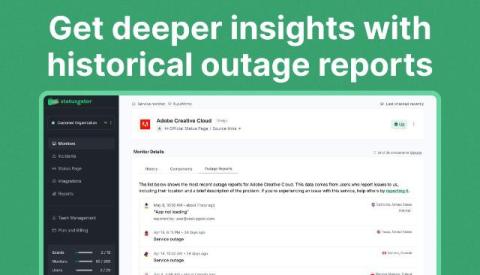

Get deeper insights with historical outage reports

StatusGator now includes a new Outage Reports tab on the service monitor detail page, giving users more visibility into recent service disruptions directly where they monitor services. Users can now quickly review recent outage activity for a specific monitored service without leaving the detail page.

The RAM Crunch: How UK Businesses Can Weather the Global Memory Shortage

Tech headlines are being dominated by the perfect storm that has led to a global shortage of Random Access Memory (RAM). As the short-term, temporary memory that handles data for processing and applications, RAM - and specifically Dynamic Random Access Memory (DRAM) - is a foundational business technology.

Cloud Outage History: Six Years of Recurring Failures

Cloud infrastructure has never been more reliable in theory. In practice, the last six years of cloud outage history have delivered some of the most disruptive incidents on record. Not because cloud providers got worse, but because the systems built on top of them got larger, more interconnected, and more brittle in ways that don't show up until everything breaks at once.

#058 - The Future of AI and Platform Engineering with Blake Sherwood (Smarsh)

In this episode, special guest Blake Sherwood joins the show to discuss his unique career trajectory from tourism and coal mining to leading massive-scale Kubernetes migrations. Blake shares insights from his experience managing petabytes of data in high-compliance environments, delving into the practical realities of integrating AI into enterprise workflows and observability systems.

Your Metrics Look Fine. Your Engineers Are About to Quit.

Developer experience predicts what's coming 3 to 6 months before it shows up in your delivery metrics. So why are most engineering leaders measuring it last? In this session, GitKraken VP of Developer Research Jeremy Castile breaks down what developer experience (DevX) actually is, how to measure it across 6 key dimensions, and how it connects to velocity, code quality, and AI impact data your team is already tracking.

Addressing Cold Start problem in Travel Personalization for OTAs

In the high-stakes world of Online Travel Agencies (OTAs) like Expedia, Hopper, Priceline, and Airbnb, seconds matter. A traveler searching for a "beachfront stay in Hawaii" isn't just looking for a room — they are reacting to weather changes, fluctuating flight prices, and social media trends. Traditional travel platforms often rely on stale data: yesterday's search history or last week's preferences. To truly compete, travel platforms must pivot to Real-Time Context Engineering.

What Is an Incident Commander? Role, Skills, and Best Practices

The fastest incident response teams treat coordination as a craft. Someone owns the call, drives the decisions, and keeps everyone moving in the same direction while the team puts the system back together. That person is the incident commander (IC), and getting the role right is what separates your 15-minute fix from a four-hour war room where nobody’s sure who’s making the call.

What Is APM? A Guide to Application Performance Monitoring

A well-instrumented service tells your on-call engineer which deploy broke checkout, which span ate the latency budget, and which line to revert before the support queue fills up. Getting there depends on how cleanly your application performance monitoring layer turns telemetry into answers. The sections ahead walk through how APM works, the metrics and components worth tracking, the cloud-native challenges at scale, and how to evaluate APM tooling against your real workload.