Operations | Monitoring | ITSM | DevOps | Cloud

The latest News and Information on DevOps, CI/CD, Automation and related technologies.

Let's talk engineering; building software by building community

For the past three years, I have been running and facilitating a community where folks from all levels and departments at CircleCI can come together to discuss diverse topics. We call it “Let’s Talk Engineering.” Some of the topics we’ve covered have been technical in nature, while others have focused more on leadership: how different teams operate, personal growth, and writing to name a few. Let’s Talk Engineering celebrates interdisciplinarity and multidisciplinarity.

Optimize your resource classes with the CircleCI resources dashboard

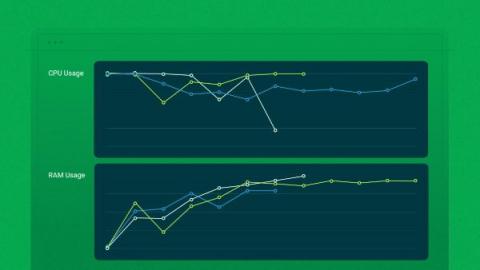
CircleCI cloud offers over 20 resource classes (varying CPU and RAM) across multiple execution environments. Finding the best resource class size for your job — not too big and not too small — can sometimes be a challenge. But now, you can view CPU and RAM usage for Docker executors within the UI. The new dashboard, found in the new Resources tab on the job details page, displays the CPU and RAM, for all parallel runs in your Docker job.

Difference Between Public, Private, and Hybrid Cloud

Cloud computing is vast. It encompasses a huge range of architectural styles, classifications, and types. This complex computing network has transformed the way we work and is a crucial part of our daily lives, both at home and at work. For organizations, there are many ways to “cloud”, but let’s start with the basics of cloud computing; the internet cloud.

AWS' Newest Official Partner: Speedscale

Speedscale is excited to join the AWS Partner Network (APN), the global community of partners who leverage Amazon Web Services (AWS) to build solutions and services for customers. AWS Partners are uniquely positioned to help businesses take full advantage of all that AWS has to offer and accelerate the journey to the cloud. As part of this achievement, Speedscale has completed the AWS Foundational Technical Review (FTR).

Kubernetes Tips: How to find the Port of a Service with a DNS request

Last week I created a guide for our users to set up an NGINX service as an API Gateway with Qovery. The API gateway must redirect the incoming traffic to the appropriate service with the correct port. My problem is that the API Gateway does not know the ports exposed for every service. In this post, I will show you a quick tip on finding the port of a Kubernetes service with a single DNS request. Let's go!

What is Server Management? Tools and Best Practices

In the digital age, organizations depend more on IT than ever before. The foundation of many IT functions -- including data storage, website hosting, emails, and software -- is server management. Without reliable, functioning servers, most IT functionality would collapse. Many businesses have migrated internal IT to cloud services using servers located in remote data centers, but a significant number still have in-house servers or use a hybrid environment of in-house and cloud services.

Platform.sh consolidates its management team with appointment of Ori Pekelman and Fabien Potencier as CSO and CPO

A major player in European cloud, created in 2015 with presence in Europe and the United States, Platform.sh is entering a new growth stage. With a team of more than 300 employees and 150 more to be added in 2022, Platform.sh is developing and consolidating its management team. Ori Pekelman, co-founder and previously Chief Product Officer (CPO), passes the torch to Fabien Potencier and becomes Chief Strategy Officer (CSO). In 2021, Platform.sh acquired Fabien Potencier's company Blackfire.io to consolidate its position as a leading platform for the management of web app fleets-making this move a logical next step.

The Impact of CVE-2022-0185 Linux Kernel Vulnerability on Popular Kubernetes Engines

Last week, a critical vulnerability identified as CVE-2022-0185 was disclosed, affecting Linux kernel versions 5.1 to 5.16.1. The security vulnerability is an integer underflow in the Filesystem Context module that allows a local attacker to run arbitrary code in the context of the kernel, thus leading to privilege escalation, container environment escape, or denial of service.