Operations | Monitoring | ITSM | DevOps | Cloud

AI: Future of IT Service Management Automation (Italian)

How does your IT team cope with increasing IT tickets, higher user expectations and an increasingly complex landscape? With limited resources at your fingertips, powering smarter work is more important than ever. Once future ambitions, AI and automation are critical today to deliver efficient, resilient IT services. In fact, 65% of IT pros predict that AI and automation will improve overall IT service quality.

Top 10 Prompts for Your Monitoring Tool

You open a monitoring tool, and the data is all there: errors, traces, anomalies, incidents, and countless intricacies. If you want to get the right slice of that data, you need to know exactly which dashboard to open and what filters to apply. But when the poor UI gets in the way, this can take longer than it should. Luckily, this is not the case with AppSignal. MCP (Model Context Protocol) changes the interface entirely.

Works on my machine: how we use AI to reproduce reported bugs

Sentry’s SDK teams maintain and support SDKs for a vast ecosystem of languages and frameworks. See our release registry for a source of truth. We’re currently at 159 published packages across the entire ecosystem. If you use it, we probably support it. All of these SDKs are open source and have their own GitHub repositories that we maintain on a daily basis. And like any other open source project, we get tons of bug reports and issues on these.

AI Automation in Telegram: How Neuro Commenting Changes Community Engagement

In recent years, artificial intelligence has significantly transformed digital communication and social media management. One of the fastest-growing platforms benefiting from this evolution is Telegram. As communities scale and content volume increases, manual engagement becomes inefficient. This is where AI-driven solutions such as neuro commenting and automation tools play a crucial role in maintaining active, responsive, and engaging communities.

MiniMax M2 vs M3: What's Actually Different and Which One Should You Use?

If you've been following open-source AI in 2026, MiniMax has probably crossed your radar at least once. The Shanghai-based lab has been quietly releasing models that punch well above their weight - and now, with M3 dropping on June 1, 2026, the question everyone's asking is: does it replace M2, or do they serve different purposes? Let's break it down clearly, without the hype.

Develop a Web App with AI: Tools, Workflow, and Best Practices

AI is transforming how people approach and build web applications. What once took weeks or even months of writing code can now be done in a matter of hours using AI-powered tools. These tools can do everything from generating wireframes to identifying bugs and automating documentation. However, developing a web app with AI isn't just about prompts and copying and pasting code. Developers must understand how to integrate AI into their workflows, validate AI-generated outputs, and follow best practices.

GPU cloud for AI inference in production: How infrastructure requirements change after training

Training a model is a project with an end date. Inference is what happens for the rest of the model's working life. The two workloads share GPUs, frameworks, and a lot of vocabulary, but the infrastructure decisions that make sense during training are usually the wrong ones in production. Teams that treat inference as "training, but smaller" tend to discover the gap somewhere around their first traffic spike.

MCP Servers Are Becoming a Core Interface Layer in Data Observability and Data Quality

Data observability has traditionally been built around human workflows. When data breaks, engineers are alerted, open dashboards, inspect lineage graphs, and manually trace the issue across pipelines. The system is designed for human investigation and interpretation. That model is now being challenged by the rise of AI agents in data operations. As organizations begin embedding AI into analytics, engineering, and decision-making workflows, observability is no longer just about explaining what happened - it must also enable systems to understand and act on it.

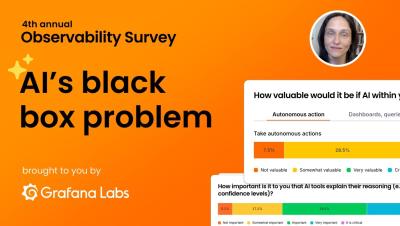
Why Engineers Don't Trust Autonomous AI - 4th Annual Observability Survey | Grafana Labs

The 2026 Observability Survey from Grafana Labs heard from over 1,300 engineers and leaders across 76 countries on the real-world role of AI in observability. The data reveals a sharp distinction between intelligence and autonomy — and a critical blind spot most teams have.