The latest News and Information on DevOps, CI/CD, Automation and related technologies.
For businesses utilising public clouds, choosing an open source platform offers considerable advantages. Open source solutions can help reduce costs, provide access to the most leading-edge enterprise-grade features, and eliminate risks such as vendor lock-in, lack of support, or long-term security maintenance.
The beauty of Shipa is that no matter how the surrounding ecosystem changes e.g your Continuous Delivery or Infrastructure-as-Code stacks, the Shipa API stays the same. If you are curious about interacting with this mystical API, there are a lot of surrounding integrations that do that for you. Though, if you want to directly interact with the API, you can send out HTTP requests to the Shipa API itself to create any sort of integration you require.
At Civo we are always committed to listening to our customers and community. In this post, I would like to highlight some of the great work the team has done to make Civo Kubernetes a go-to choice for enterprises.
Containers are no longer a thing of the future – they are all around us. Companies use them to run everything – from the simplest scripts to large applications. You create a container and run the same thing locally, in the test environment, in QA, and finally in production. A stateless box built with minimal requirements and unlike virtual machines – without the need of virtualizing the whole operating system.
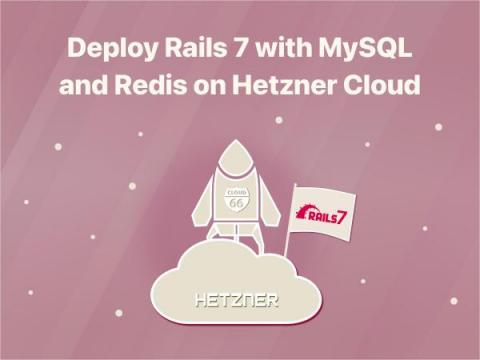
We have created a simple Rails 7 application to showcase how easy it is to deploy to Hetzner Cloud with Cloud 66.
2021 marked the fifth consecutive year of record-breaking security attacks. Zero-Day attacks skyrocketed, with 66 exploits found to be in use, more than any other year on record and almost double 2020’s figure. Meanwhile, a staggering 66% of organizations have suffered at least one ransomware attack in the last year, with the average ransom payment soaring by 63% to $1.79 million (USD).
A well-maintained, accurate configuration management database (CMDB) is the cornerstone of successful IT operations, offering clarity about what’s in your environment and how it all works in tandem. Yet, statistics indicate that only 25% of organizations are actually receiving meaningful value from their CMDB investments. This is due in large part to ever-changing IT assets and the increasing complexity of infrastructure and applications.
Kubernetes is a rich ecosystem, and the native YAML or JSON manifest files remain a popular way to deploy applications. YAML’s support for multi-document files makes it often possible to describe complex applications with a single file. The Kubernetes CLI also allows for many individual YAML or JSON files to be applied at once by referencing their parent directory, reducing most Kubernetes deployments to a single kubectl call.
When building an incident response process, it’s easy to get overwhelmed by all the moving parts. Less is more: focus first on building solid foundations that you can develop over time. Here are three things we think form a key part of a strong process. I’d recommend taking these one at a time, introducing incident response throughout your organisation. Just being honest: we’re a startup selling incident management software.