Operations | Monitoring | ITSM | DevOps | Cloud

The latest News and Information on DevOps, CI/CD, Automation and related technologies.

OpenStack Yoga on Ubuntu LTS delivers highly performant infrastructure for telcos and researchers with SmartNICs and DPUs

March 31, London – Canonical today announced the general availability of OpenStack Yoga on Ubuntu 22.04 Long Term Support (LTS) Beta and Ubuntu 20.04 LTS. This new version of OpenStack sets a foundation for next-generation, highly performant infrastructure as needed by telco NFV, media streaming, traffic analysis and HPC services, using SmartNIC cards and integrating them with the Neutron Open Virtual Network (OVN) driver.
Announcing Prepress v2

Today I am very excited to announce a major new version of Cloud 66 Prepress, our No Ops tool for deploying static sites. Last year we released Prepress to help our customers deploy static sites to AWS S3. With support for Jekyll, Hugo, and Gatsby, Prepress is everything you need to deploy your static site to your account on all major cloud providers. Today, we are taking Prepress to a whole new level.

Building Your Security Analytics Use Cases

It’s time again for another meeting with senior leadership. You know that they will ask you the hard questions, like “how do you know that your detection and response times are ‘good enough’?” You think you’re doing a good job securing the organization. You haven’t had a security incident yet. At the same time, you also know that you have no way to prove your approach to security is working. You’re reading your threat intelligence feeds.

A guide to Linux for embedded applications

An embedded device is a hardware and software system that performs a dedicated function within a larger computer system. It is typically resource-constrained and comprises a processing engine. The software of an embedded Linux system runs on top of the Linux kernel, the fundamental core of the OS with complete control over everything occurring in the system. It follows an embedded Linux system simply denotes an embedded system running on the Linux kernel.

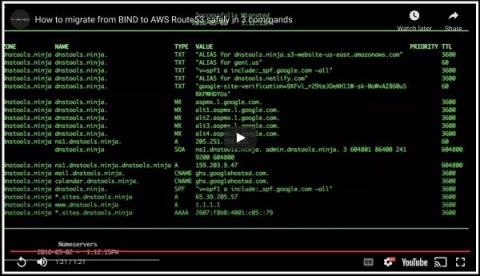
How to Migrate from BIND to AWS Route53 Safely in 3 Commands

Migrating your DNS to a cloud provider like Amazon’s Route53 service can be a daunting task. Thankfully, with dns-tools you can test your DNS records before and after the migration to ensure that everything made it across in one-piece. This is the three steps we follow when migrating to Route 53: Follow along below and in just 10 minutes you’ll know if everything will migrate smoothly for you.

How Lightspeed optimized iOS test runs with parallelism and caching

At Lightspeed, we maintain multiple large iOS projects as well as their modularized dependencies. The last year of acquisitions brought together many different approaches to CI/CD at our company. I recently led the initiative to bring these projects and practices into alignment. In this post, I will explain the goals we had for our continuous integration pipeline and the implementations we used to achieve them.

Scheduling load tests and persisting output with k6

In this k6 series I have covered HTTP request testing with k6 and performance testing with k6. I designed these tutorials to introduce you to k6 and to show you how to use k6 for performance testing of microservices. As the third tutorial in the k6 series, this will cover how you can store your k6 test results locally and also how to schedule your load tests using CircleCI’s scheduled pipelines feature.

CloudZero Achieves SOC 1 Compliance: Here's Why We Did It

For most companies it’s difficult to organize cloud spend because it relies on manual effort, like tagging. At CloudZero, we’re dedicated to helping customers make sense of their cloud investment without manual and repetitive work. Our code-driven approach to cost allocation makes it easy for customers to organize spend even if they have poor tagging, shared resources, or containerized infrastructure. Quite simply, we organize cloud spend better than anyone else in the world.