Operations | Monitoring | ITSM | DevOps | Cloud

The latest News and Information on Observabilty for complex systems and related technologies.

Monitoring & Observability for Sales, Marketing and Business ops teams with StackMoxie and PagerDuty

Before Stack Moxie, every business ops team needed PagerDuty, but finding and pushing errors was a manual process. With Stack Moxie + PagerDuty, every business op professional can manage their sales, marketing, HR or customer success stack with the same quality engineers bring to code.

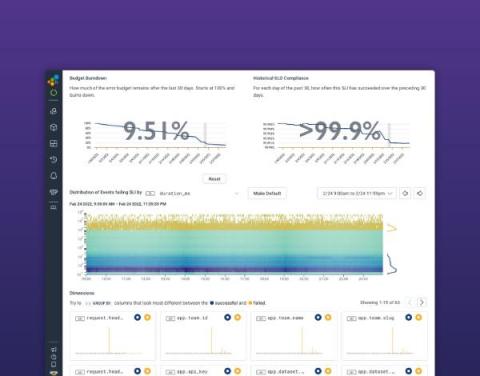
Implementing SLAs, SLIs, and SLOs in an observability suite

Implementing SLAs, SLIs, and SLOs in an observability suite is now business-critical. Over time, a company’s decision-makers can add a burdensome number of KPIs that force servers and other IT assets to devote excessive processing time to business intelligence. Eventually, the burden becomes so great that employees, managers, and executives start to complain about the system’s sluggishness. Developers know that they need to strike a balance between business needs and IT processes.

Serverless Observability: It's easier than you think!

Observability is a measure of how well the internal state of a system can be inferred from its external outputs. It helps us understand what is happening in our application and troubleshoot problems when they arise. It’s an essential part of running production workloads and providing a reliable service that attracts and retains satisfied customers.

Observability into Your FinOps: Taking Distributed Tracing Beyond Monitoring

Distributed tracing has been growing in popularity as a primary tool for investigating performance issues in microservices systems. Our recent DevOps Pulse survey shows a 38% increase year-over-year in organizations’ tracing use. Furthermore, 64% of those respondents who are not yet using tracing indicated plans to adopt it in the next two years. However, many organizations have yet to realize just how much potential distributed tracing holds.

Observability - An Ultimate Guide

A developers perspective is different. While managing various sectors in a software, sometimes it would be difficult to monitor the activities and identify the bug that is disrupting the functions. What if you can spot the error beforehand, and resolve it at the earliest? The strategies that we focus on, and implement are the ones that help us effectively manage our tasks. That is possible by knowing about Observability. Let's learn in detail about it through this blog. TABLE OF CONTENTS.

Incident Resolution: Do You Remember, the Twenty Fires of September?

From September to early October, Honeycomb declared five public incidents. Internally, the whole month was part of a broader operational burden, where over 20 different issues interrupted normal work. A fraction of them had noticeable public impact, but most of the operational work was invisible. Because we’re all about helping everyone learn from our experiences, we decided to share the behind-the-scenes look of what happened.

Introducing Grafana Enterprise Traces, joining metrics and logs in the Grafana Enterprise Stack observability solution

Today, we are launching a new Grafana Labs product, Grafana Enterprise Traces. Powered by Grafana Tempo, our open source distributed tracing backend,.and built by the maintainers of the project, this offering is an exciting addition to our growing self-managed observability stack tailored for enterprises.

What's Wrong With Observability Pricing?

There’s something wrong with the pricing of observability services. Not just because it costs a lot – it certainly does – but also because it’s almost impossible to discern, in many cases, exactly how the costs are calculated. The service itself, the number of users, the number of sources, the analytics, the retention period, and extended data retention, and the engineers on staff who maintain the whole system are all relevant factors that feed into the final expense.

Game Launches Should Be Exciting for Your Players, Not for Your LiveOps Team

The moment of launching something new at a game studio (titles, experiences, features, subscriptions) is a blockbuster moment that hangs in the balance. The architecture—distributed and complex, designed by a multitude of teams, to be played across a variety of devices in every corner of the world—is about to meet a frenzy of audience anticipation, along with the sky-high expectations of players, executives, and investors.