Operations | Monitoring | ITSM | DevOps | Cloud

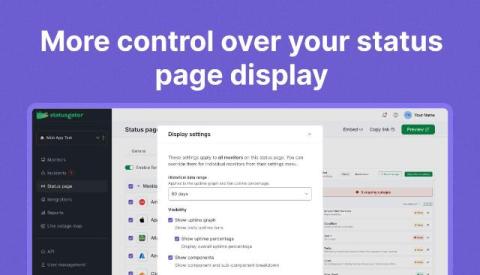
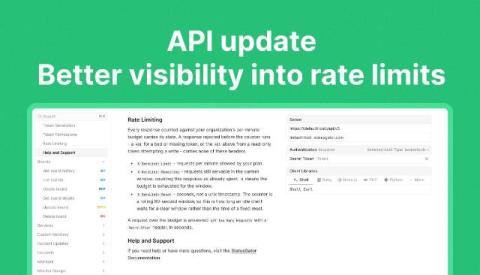
API update: Better visibility into rate limits

We’ve updated the StatusGator API v3 to help you see how many requests your integration can make and handle rate limits more smoothly. Responses that count toward your organization’s per-minute limit now include three headers: If a request exceeds your limit, the API returns 429 Too Many Requests and a Retry-After header telling your integration how many seconds to wait before trying again.

Devart Data Access Components add support for the latest IDEs and database platforms

The latest update to Devart Data Access Components is here, bringing support for RAD Studio 13 Florence Release 2, Lazarus 4.8, Microsoft SQL Server 2025, MySQL 9.7.x, and NexusDB 4.75.20. The release also introduces new security and authentication capabilities, along with improvements to transaction management, database connectivity, data handling, and performance.

env zero Launches EZ Control, the Autonomous Cloud Control Plane for the AI Era

Industry-Leading Asset Coverage Spanning Nearly 2,300 Resource Types Across AWS, Azure, Google Cloud and Kubernetes, Structured into a Real-Time Ontology That EZ Control Uses to Enforce Security, Cost, Availability, Maintenance and Performance Policies Continuously.

Debugging a checkout latency spike with Sentry metrics

Checkout suddenly got a lot slower for a chunk of users, and the only clue was a spike in an application metric. In this walkthrough, we go from that spike to a linked trace that shows exactly where the time went. Using Codex alongside Sentry, we dig into the trace data, isolate the slowdown to the European backend, and follow it down to a single Stripe request that's dragging everyone down with it. Along the way, we talk through what actually helps here: caching, timeouts, async calls, and other ways to keep one slow dependency from becoming everyone's problem.


Opensearch, AI, and a Grab-bag of topics with Jay Miller and Dima Kan

Fireside chat between Jay Miller, Developer Advocate at Aiven and Dima Kan, Staff Product Manager for OpenSearch about the role of search in AI. AIVEN DATA PLATFORM The Aiven Platform is more than a collection of open source services for streaming, storing and analyzing data. The platform ensures that all services run reliably and securely in the clouds of your choice, are observable, and can easily be integrated with each other and with external 3rd party tools.

Valkey Observability with BetterDB on Aiven Runtime - Kristiyan Ivanov

My interview guest is Kristiyan Ivanov creator of BetterDB. In this conversation we talk about building tools to observe Valkey and Redis as well as AI Observability, the Valkey Community and More! Learn more about AIVEN DATA PLATFORM The Aiven Platform is more than a collection of open source services for streaming, storing and analyzing data. The platform ensures that all services run reliably and securely in the clouds of your choice, are observable, and can easily be integrated with each other and with external 3rd party tools.

Juggling AI tools works, until it does not

This isn't a teardown. This stack is a genuinely reasonable way to start. An AI-first editor handles day-to-day writing. A terminal-based coding agent takes on tasks that need more autonomy: a full feature, a migration, a stubborn bug. A few scripts connect the pieces, trigger a run, and post a result somewhere. An observability tool checks what happened after the fact. Every part of that is a real, capable tool. For the first few months, on a small team, it works.