Operations | Monitoring | ITSM | DevOps | Cloud

PCI DSS Requirement 10: Logging and Monitoring in v4.0.1

Version 4.0 renumbered PCI DSS Requirement 10 from end to end, and the Council retired v3.2.1 on 31 March 2024. Sub-requirement numbers written before then mostly point somewhere else now. Four more Requirement 10 rules changed status on 31 March 2025, automated log review among them. Checking your numbering against v4.0.1 costs an afternoon and saves a finding. In this blog, you will: PCI DSS Requirement 10 covers audit logging and monitoring across the cardholder data environment.

IT Service Management for Government and Public Sector Organizations

What happens when a citizen-facing portal fails on the last day of a filing deadline, and the only record of the outage lives in an email thread between two engineers? In a commercial organization, that is an operational embarrassment. In a government department, it is a hole in a statutory record that an auditor will eventually ask about.

ITSM for Healthcare: IT Service Management in Hospitals and Health Systems

How long does a nurse stand at a workstation waiting for a record to load before the ward gives up and reaches for paper? In most hospitals nobody measures that number, and the ticket that reaches IT describes a symptom instead of a cause. Hospital IT support runs on a different clock from corporate IT. There is no quiet Sunday night and no safe window for maintenance.

Log Filtering: How to Cut Log Ingest Volume Without Losing Evidence

Every log estate reaches a point where volume grows faster than the value inside it. The usual response is to find the biggest source and drop it. Cutting volume is the easy part. Cutting the right half takes judgment. Log filtering is only one of four options for an expensive source, and the other three matter just as much. In this blog, you will: By the end you can defend every rule you write, including the ones that keep data. A volume cut fails in two directions.

Agent vs Agentless Monitoring and How to Decide What Goes Where

Why does half the infrastructure end up returning no monitoring data? The standard plan is to install collection software on everything, which moves quickly across servers and stops dead at the first device running closed firmware. Storage arrays, firewalls, and switches will never accept an install, and the rollout stalls there. That plan usually gets set once for the whole environment, with a single collection model applied to hardware it was never suited for.

Help Desk Software for Schools: Managing IT Support Across Campuses

How many support requests reach school IT staff each week without ever becoming a ticket? A teacher stops a technician in the corridor about a projector that will not connect. An office administrator sends a direct email about a locked account, and a student tells the librarian their laptop stopped charging during second period. Help desk software for schools collects those requests into one queue, routes them by site and category, and keeps a record of what was done.

10 Top Website Monitoring Tools for Uptime, Page Speed and Real User Data

Your uptime tool reports the site as available all month. Support reports something else, because customers in one region spent the morning unable to complete a checkout. Both records are accurate, and that is the problem. An external check confirms the page answered. It cannot tell you that the answer took nine seconds for everyone routed through one CDN edge, or what caused the delay.

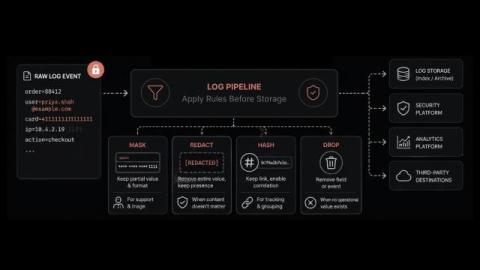
PII Redaction in Logs: Mask, Redact, Hash, or Drop?

Sensitive values reach your logs without anyone deciding they should. A debug line prints a whole request object. An error message carries the query string. A customer email address is suddenly stored in three systems. PII redaction in logs then gets treated as one setting to switch on. In practice it covers four separate treatments. The value is already inside the message before log ingestion finishes. In this blog, you will: By the end you can write a rule for each field and defend it.

Log Processing: What Happens to a Log Line Before You Can Search It

A log line arrives as plain text and leaves as a record you can query. Six steps sit between those two states. Each one adds something useful, and each one costs you time, CPU, or storage. Most teams never look at that chain until a search comes back empty. Here is what log processing does to an event, step by step: By the end you can look at your own chain. You will know what each step buys you. Six steps turn a raw log line into a searchable record.

Best Storage Monitoring Software: 10 Tools Compared

Storage rarely fails loudly. A pool fills. Latency climbs on one LUN. The first to notice is a user whose application timed out. The best storage monitoring software catches it earlier. It watches capacity, IOPS, latency and drive health across your arrays, which is what storage resource monitoring is for. In this blog, you will see: By the end you will know which one fits. Storage monitoring software tracks the health, capacity and performance of your IT storage.