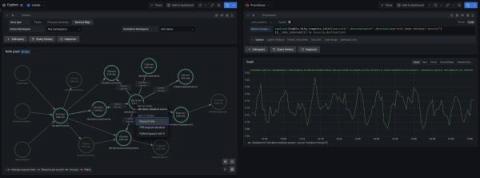
Logz.io is excited to announce Service Overview, a fast and easy way to unify telemetry data and insights across your infrastructure and applications into a single interface. Our Beta users have reported simplified observability, faster time-to-insights, and observability consolidation.
Core Web Vitals (CWV) are Google's preferred metrics for measuring the quality of the user experience for browser web apps. Currently, Core Web Vitals measure loading performance, interactivity, and visual stability. These are the main indicators of what a user’s experience will be while using a web page.
At Lumigo, we see ourselves as your reliable ally in the noble mission of detecting and vanquishing troublesome issues that lurk within your serverless and container applications. Our secret sauce? Equipping you with a wealth of detailed trace data, ensuring you’re always well-lit and ready for battle when the nefarious ‘bugs’ make their unsolicited appearances.
In a rapidly evolving realm of IT, organizations are constantly seeking peak performance and dependability, leading them to rely on a reliable observability platform to obtain valuable system insights. Logs vs metrics play a vital role, as any full-stack observability guide would tell you, serving as essential elements for efficient system monitoring and troubleshooting. But what are logs and metrics, exactly?
No-code, low-code, and bring-your-own-code (BYOC) platforms refer to different types of software development approaches that cater to varying levels of technical expertise, allowing users to create applications, websites, and automate tasks with differing degrees of coding requirements.
Anna Kapuścińska is a Software Engineer at Isovalent, who has a rich experience wearing both developer and SRE hats across the industry. Now she works on Isovalent observability products such as Hubble, Tetragon, and Timescape, as well as the respective Grafana integrations for all of them.