Operations | Monitoring | ITSM | DevOps | Cloud

Code Refactoring and why you should refactor your code

Software does not expire, but it “rots”. Its quality degrades over time. As you build your project and add features, you probably won’t always build it in a clean, orderly and mindful way. Especially if you have a tight deadline. So aside from features, you also produce bugs, code smells, and technical debt. That “rots” your software, but your job as a software engineer is to maintain its “freshness” while building on top of it.


The Goal With Every Release: Stay Laser Focused on Driving Value for Customers

As our customers share their frustrations with the volume and growth of their observability data, we’ve got our eyes set on making it easier to manage. Our Spring 4.1 Launch involved enhancements to the Cribl suite of products — Cribl Stream, Cribl Edge, and Cribl Search — that give users more choice and control over their end-to-end observability architecture.

Data Integration: The Techniques, Use Cases, and Benefits You Need to Know

In a world where data is continuously growing, the need for integrated and centralized data is becoming increasingly important. Businesses are becoming more data-intensive, and by 2025, organizations need to leverage the power of their data to make informed decisions and stay competitive. Data integration plays a crucial role in enabling businesses to access, analyze and act on such data, with the data integration market expected to grow at a fast pace of a CAGR of 11.4% in 2027.

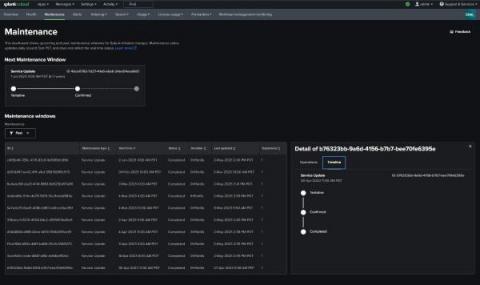
Announcing the General Availability of Cloud Monitoring Console's Maintenance Dashboard

Calling all Splunk Cloud Platform admins! At Splunk, we're dedicated to making your lives easier when it comes to managing various aspects of your Splunk Cloud Platform. One critical aspect that requires your attention is maintenance, which directly impacts the operational efficiency of your deployments. As the capabilities of the Splunk Cloud Platform grow, so do the Splunk-initiated updates like upgrades to keep your deployments up-to-date with the latest features and functionality.

IT Asset Tagging: How to Tag Software and Hardware Assets

When managing assets across your organization, IT asset tagging acts as a starting block. It ensures that everything is properly identified and easily tracked to avoid inaccurate inventory records, unregistered losses, or misusage. The practice provides a systematic approach to label and identify software and hardware assets to easily track relevant information throughout the asset’s whole lifecycle.

NetOps in Action: Fidelity National Information Services, Inc. (FIS)

Fidelity National Information Services, Inc. (FIS) is an American multinational corporation which offers a wide range of financial products and services. FIS is most known for its development of Financial Technology, or FinTech. FIS has a portfolio of products for the financial services sector, including both retail and investment banking. FIS global customers connect to services from FIS’s Little Rock, AR datacenter.

How AIOps Revolutionizes Observability for TechOps Teams

Managing over 1000 services and applications is daunting for any organization’s IT and Tech operations team. With a diverse mix of on-premises legacy systems and modern cloud stacks, the sheer volume of activity can overwhelm even the most skilled ITOps teams. The task is made more difficult by the fact that observability is fragmented. On average, organizations depend on 21 systems that produce metrics, logs, traces, and alerts for various services.

3 models for logging with OpenTelemetry and Elastic

Arguably, OpenTelemetry exists to (greatly) increase usage of tracing and metrics among developers. That said, logging will continue to play a critical role in providing flexible, application-specific, event-driven data. Further, OpenTelemetry has the potential to bring added value to existing application logging flows.

Relativity uses Elasticsearch and Azure OpenAI to build futuristic search experiences, today

Elasticsearch® has been used by developers to build search experiences for over a decade. At Microsoft Build this year, we announced the launch of Elasticsearch Relevance Engine™ — a set of tools to enable developers to build AI-powered search applications. With generative AI, large language models (LLMs), and vector search capabilities gaining mindshare, we are delighted to expand our range of tools and enable our customers in building the next generation of search apps.