Operations | Monitoring | ITSM | DevOps | Cloud

The latest News and Information on Observabilty for complex systems and related technologies.

How to Prevent AI Agents From Deleting Production Data

There’s a new question teams are asking. How can we prevent AI agents from deleting production. When Cursor deleted PocketOS’s entire production database in nine seconds, the agent wasn’t malfunctioning. It had full technical capability, but it was inferring operational authority from static code rather than live environment state. That gap between capability and context is the root cause. This article breaks down exactly how that happens, and what runtime visibility does to stop it.

The cost of knowledge

In the world of observability, “cardinality” has become a heavy word. It is a ghost used to justify skyrocketing bills or degraded query performance. When cardinality rises, the advice is almost always the same: reduce it. Drop your labels, or reduce the dimensions. It is usually framed as “optimization.” Every label you add to a metric is a dimension of knowledge. Each one gives you a way to slice, compare, and explain the chaos of production.

Moving Beyond SolarWinds: A Guide to Modern Observability

Industry-leading observability experts provide strategic guidance on why and how modern IT teams are successfully moving beyond SolarWinds to more resilient, cloud-native platforms. IT teams running SolarWinds often know the pain points well before they start evaluating alternatives: separate modules for different monitoring needs, a self-hosted deployment model that requires ongoing maintenance, and pricing that gets harder to predict after each acquisition.

How Scalability Works in SolarWinds Observability Self-Hosted

Cheryl Nomanson, SolarWinds staff technical trainer, provides a comprehensive overview of SolarWinds architecture and scaling options for self-hosted deployments. She explains the centralized deployment model starting with a single SolarWinds server that handles polling, web console, and database connections. The presentation covers key scaling indicators including polling thresholds that warn users at 85% capacity and alert at 100%. She demonstrates how to add up to 100 polling engines per server and additional web servers to handle more concurrent users.

Observability vs Monitoring: What's the Real Difference in 2026?

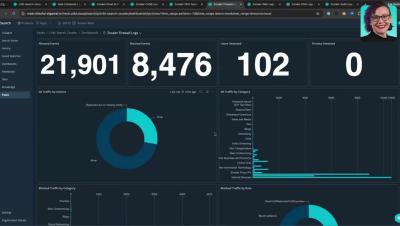
Understand the real difference between observability and monitoring — and why modern IT teams in 2026 need both. Monitoring tells you something is broken; observability explains why. See real examples, faster troubleshooting workflows, and how Motadata ObserveOps unifies both in one platform. Don’t forget to like, share, and subscribe for more IT insights.

Introducing the Coralogix CLI: Headless Observability for Every Agent

This article is a high-level overview of the Coralogix CLI. For a deeper look at how it works in practice, read the full technical deep dive here. Agent-driven investigation sounds simple: read the alert, query the data, return the cause. In reality, most agents either overload their context window with raw logs or guess at queries and return incorrect results.

Taming Log Noise With the OpenTelemetry Collector's Drain Processor

Do you receive 50 million log lines per day and struggle to see what actually matters? Health checks, heartbeat pings, connection pool messages—they all drown out the errors and anomalies you're trying to find. Most teams deal with this by writing filter rules to drop the noisy patterns. But those rules are manual, per-pattern, and brittle. A new deployment changes a log format and the filter misses it. A new service starts logging a chatty startup sequence nobody thought to exclude.

Get Observability in the Terminal, for You and Your Agents: gcx

The way you write code is changing, which means the way you observe your systems and respond to issues needs to change, too. Engineers today spend much of their day working via command line, as agentic tools like Cursor and Claude Code have become highly effective at handling many day-to-day engineering tasks. This greatly accelerates code generation, but it doesn't solve for the context switching that comes when you have to jump into another tool that's not part of this new, faster workflow.