Operations | Monitoring | ITSM | DevOps | Cloud

SAP Cloud ALM vs Solution Manager: What's Actually Changing

For most SAP customers, Solution Manager has been the system of record for how change happens. It has run ChaRM to control transports, hosted the IT service management queue for incidents and requests, driven test management and process documentation, and provided the monitoring layer for many on premise landscapes. It has done this job, largely unnoticed, for two decades.
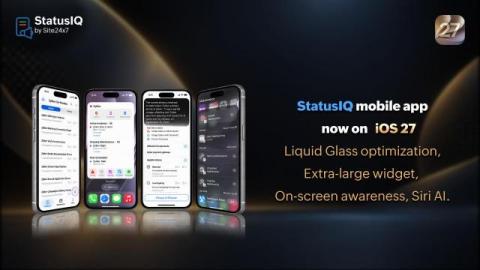
How we built iOS 27 into StatusIQ: Onscreen awareness, Siri actions through Spotlight, a one-stop widget for key information, and Liquid Glass optimization

When an incident hits at 2am, every second of context switching adds risk. The latest StatusIQ iOS update is built around one principle: Get the right information and the right actions to your team faster, with less friction. With iOS 27 support now live in the StatusIQ mobile app, here's what's changed and why it matters.

ilert AI SRE is generally available

When you get paged at 3am, it takes about 30 seconds for the notification to reach you and maybe two minutes until you're in front of a laptop, awake enough to read. What you see then is usually a raw alert. A metric name, a threshold, a link to a dashboard. Then the ritual starts: open the dashboard, check what deployed in the last few hours, grep the logs for the first error, ask in Slack whether anyone touched the database. ‍ Most of that time is search.

You Can Have Your Pi and Kepler It Too

One of the features I have been wanting in Kepler for a long time was the ability to use Pi as my agent when spinning up tasks. Pi is such a minimal harness that it doesn’t prompt for approval for every little thing and it’s system prompt let’s the model just be itself. That minimalism comes at a cost, though. Pi doesn’t have ACP support out of the box, so that means we haven’t been able to officially support it in Kepler, yet.

JFrog Agent Power for AWS Kiro

JFrog is bringing software supply chain governance to AWS Kiro. Operating as a power plugin within Kiro, JFrog delivers package safety, agentic access to the JFrog platform, and the JFrog AI Catalog. With simple setup, AI agents make supply chain aware decisions right inside the IDE, ensuring dependencies come directly from Artifactory rather than unverified public registries.

First Look: Build Grafana Dashboards with AI using the MetricFire MCP Server

Get a first look at what’s coming next to the MetricFire MCP Server: AI-powered dashboard creation and management. We’re connecting the Hosted Graphite HTTP Dashboard API to our MCP Server, letting compatible AI clients work with your monitoring data and Grafana dashboards directly through an AI-assisted workflow. Soon, you’ll be able to use natural language prompts to reference metrics stored in Hosted Graphite and create, update, and manage dashboards.

Digital Experience Monitoring with Grafana Cloud: Session Replay, synthetic checks, and faster investigations

When something breaks in production, the questions that matter most are also the toughest to answer from metrics alone: who was affected, what did they actually see, and is this worth waking someone up for? Answering those questions requires a fuller picture of the issue and its impact on your users. That’s where Digital Experience Monitoring (DEM) in Grafana Cloud comes in.

Installing CFEngine with Ansible

You started with Ansible, and for a long time it was the only thing you needed. With a handful of playbooks and an inventory file, you got the job done. However, as the fleet grew, runs went from taking minutes to hours, and parts of the inventory were unreachable at any given moment. This is not an Ansible flaw. Push-based configuration and continuous state enforcement are simply two different jobs. This blog post is all about getting you started with a hybrid system.

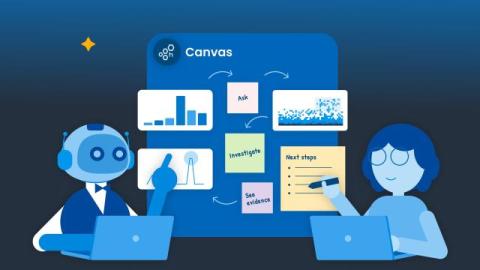
How Canvas Powers the AI Agent Development Feedback Loop

For teams building AI agents, the feedback loop should already be a familiar idea: watch how the agent behaves, find what needs improvement, ship a change, and measure the result. In theory, each turn builds on the last until the loop becomes a flywheel and your agent is getting more effective with each turn. In practice, many of us are still in reaction mode. A user reports something strange, costs spike, or an eval score drops.