
Operations | Monitoring | ITSM | DevOps | Cloud

How to Integrate OpenTelemetry with Logit.io

When telemetry data (collected from system sources in observability) is analyzed collectively it provides insights into the relationships and dependencies within a distributed system. OpenTelemetry standardizes the collection and transmission of telemetry data to backend platforms, closing visibility gaps by offering a unified instrumentation format across all services.

How to Integrate .NET with Logit.io

If you use the programming language C# there’s a chance that you’re already familiar with.NET (pronounced ‘dot net’), an open-source application platform supported by Microsoft. C# is the programming language for.NET but the platform can run programs written in multiple languages. Microsoft’s ambition with.NET is to offer developers one platform to solve any problem.

How to Integrate Python Logs with Logit.io

Debugging Python code is crucial for guaranteeing the uptime and performance of your application, and logging in Python is a great solution to streamline your debugging workflow. Python, a general-purpose programming language, includes a logging module in its standard library, offering a flexible framework for generating log messages from Python programs.

How to Integrate Filebeat with Logit.io

Filebeat is a straightforward log shipper that enables you to begin logging, rapidly. With observability solutions like Logit.io, this can be achieved in as little as 5 minutes, following our integration guide. To understand more about using Filebeat with Logit.io, this article will define what it is, how it works, and how to integrate Filebeat with Logit.io to ship logs from local files to one or more destinations.

How to Integrate Node.js with Logit.io

Node.js is an open-source runtime environment, frequently used for backend development, and enables developers to build scalable, high-performance apps that can easily handle a vast amount of simultaneous connections. The solution is suitable for network applications scalable for real-time web apps, RESTful APIs, microservices, and chat apps.

How to Integrate Java with Logit.io

Java is a popular programming language, developed almost 30 years ago by Sun Microsystems, based on the main theory of ‘write once, run anywhere’ (WORA). Due to Java having been around for a long time, numerous learning resources are available for new developers which further adds to its popularity. Also, Java code can operate on any underlying platform like Windows, Linux, iOS, or Android without rewriting.

AlertOps Announces Integration with ServiceNow to Enhance Incident Management and Response

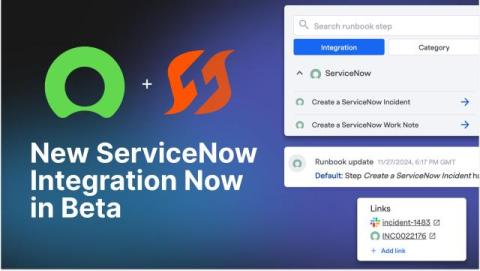
AlertOps announced its new integration with ServiceNow to enhance incident management and response capabilities for ServiceNow customers. This joint effort enables AlertOps to create better experiences and drive value for customers by providing real-time notifications, bi-directional data synchronization, and seamless integrations. ServiceNow’s expansive partner ecosystem and partner program is critical in supporting the Now Platform’s $275 billion forecasted market opportunity through 2026.

How To Integrate Ruby with Logit.io

Developed in the mid-1990s, Ruby is a dynamic, open-source programming language. The tool has grown in popularity from its initial release, having been used in modern systems covering a variety of corporate and academic use cases. Ruby gained further traction after the release of Ruby on Rails, a powerful web application framework written in pure Ruby.

How to Integrate Serilog with Logit.io

Serilog offers users a streamlined logging framework for.NET applications and cloud services. The tool enables users to adjust logging levels, enrich log events with additional properties, and switch between different sinks without modifying the application code. The simplicity of Serilog, its support of structured logging, and compatibility with asynchronous applications and systems are a selection of the tool's features that have led to it being commonly used across a variety of organizations.