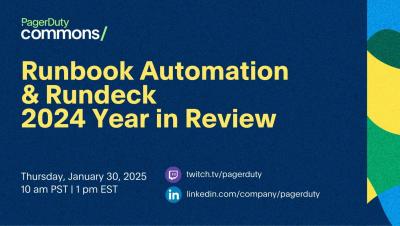
"CFEngine: The agent is in" is our monthly webinar series, where we show new features, teach best practices, and keep the community informed about everything CFEngine.
As organizations scale, managing IT systems and resolving incidents efficiently becomes increasingly complex. Manual processes, while functional in smaller setups, often fall short in speed, accuracy, and scalability. Enter Runbook Automation (RBA)—a transformative approach to streamline and standardize incident resolution. This blog explores what Runbook Automation is, its significance in modern IT operations, and best practices to implement it effectively.
CFEngine build modules are great for quickly integrating 3rd party policy into your policy set. Module input (not to be confused with inputs in body common control or body file control which are the list of policy files to load) allows you to define values that apply for a particular module as it’s integrated into your policy set. Let’s take a look at a case of extending a module to support input.
Let’s face it—today’s IT environments are messy, complicated beasts. Between hybrid clouds, sprawling networks, legacy systems, and digital transformation demands, the need for intelligent automation and orchestration has never been greater. That’s where Service Orchestration and Automation Platforms (SOAPs) come in. Think of them as the conductors of your IT symphony, ensuring all the instruments (tools, teams, and systems) play together harmoniously.
Ever need to make a decision based on the version of something? The version_compare() function might be useful for you.1 Over time, software changes and features are added and removed. Sometimes, we need to make a decision based on versions. For example, the Include directive in ssh_config was introduced in OpenSSH 7.3.2 Let’s take a look at how we could possibly use it. This example illustrates the basic use of version_compare()
As businesses scale, managing infrastructure becomes increasingly complex and distributed, leading to challenges in consistency, performance, and security. Manual configurations and outdated practices can no longer meet the demands of today’s highly competitive businesses. To tackle these issues, adopting a phased approach; Day 0, Day 1, and Day 2; provides a practical roadmap for scaling infrastructure automation effectively.
As networks become more complex, the demand for automation has surged. There has been a huge uptick in the concept of autonomous networks—a transformative model redefining how telecom and IT networks operate. But what are they, and why are they essential for today’s digital-first world? Let’s break it down.
Software deployment automation can simplify and speed up your delivery cycle. It can reduce risk, allow teams to easily test after changes are made, and help provide consistency for the overall development pipeline. If it sounds complicated, we’re here to break it down each step into a cheat sheet that provides tips and best practices for the software deployment automation process.
Let’s face it: managing IT operations today feels a bit like spinning plates in a hurricane. Alerts are pinging, systems are stalling, users are shouting (as if that’ll help), and all the while, you’re drowning in a sea of repetitive, manual tasks. Sound familiar? Welcome to the wonderfully chaotic world of IT. But it doesn’t have to be this way.
Every operating system has its quirks, and Linux security is no different. Whether you’re on Team Penguin or running mostly Windows boxes (or a bit of both), you’ll need to take different steps to manage security on different OSes. Like any OS, Linux security comes with its own peculiarities, pitfalls, and best practices.