Operations | Monitoring | ITSM | DevOps | Cloud

Latest posts

Elastic Agent and Fleet

Instrumentation and data onboarding are often the most time-consuming tasks in any observability or security initiative. Learn how we are reducing time to insight by simplifying the full instrument-to-action workflow: (1) collect all telemetry data from a host with the Elastic Agent, (2) parse custom data before ingest using an intuitive UI, (3) protect endpoints from security threats with automated response, and (4) centrally manage your entire fleet of agents from a single pane.

Elastic: Infrastructure metrics and observability with the Elastic Stack

Ready to get started on your observability journey? We'll go over the basics of using the ELK Stack for your infrastructure and system metrics analytics. We'll also show how combining your infrastructure metrics with your logs and application traces can benefit you and your business. Join us to see how Elastic Observability can help you get to the bottom of issues faster and reduce your MTTD/R.

StatsD: What Is It and How To Monitor It

StatsD is among the most popular monitoring solutions used to instrument code with the help of custom metrics. It has become very popular over the course of the last few years and emerged as the industry standard for open source inside-the-app monitoring. It has a host of advantageous features that makes it perfect for application performance measurements.

How to find Azure BLOB files that haven't been accessed

Azure storage has provided companies with a way to store almost limitless amount of data. But just like kids in a candy store this can get out of hand, and expensive. Being able to store as much data as you want is great, however it is something that can grow to a point where you are spending more on storage than you actually need.

Accelerate Your APIs by Using the HAProxy Cache

The age of rendering most of a web page’s contents on the server and then delivering it as a colossal HTML file is fading into the past. Modern web frameworks like Angular, React, and Vue push towards creating components instead—individual elements on the page that fetch their data in the background and poll for asynchronous updates—which can be reused across your site.

Honeycomb Learn Ep 1 Instrument Better for a Happy Debugging Team

Nathan LeClaire, Sales Engineer @honeycombio knows first-hand that the key to instrumenting code is to start with baby steps. With Honeycomb, a little instrumentation will give vast insights as soon as you ingest your data. With Honeycomb Beelines, we take the heavy lifting out of instrumenting. Listen to learn: See Honeycomb in action, hear best practices, and learn how fast and painless instrumentation can be.

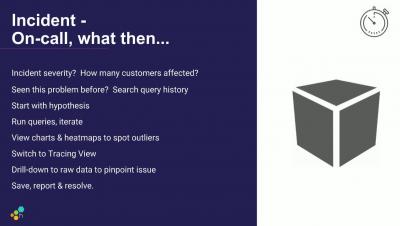
Honeycomb Learn Ep. 2: De-stress Debugging -Triggers, Feature Flags, & Fast Query

This episode in our Honeycomb Learn series looks at how to cut stress levels when debugging issues in production. Starting with a hypothesis, run fast queries, and then navigate to the code where the problem lies. Be proactive and set triggers to let you know if something needs attention. When engineering is about to ship a new release, set a feature flag to watch how production behaves in real-time. Curtail performance issues and reduce customer impact with the right tools to better understand production systems, right now.

Honeycomb Learn Ep. 3: See The Trace? Discover Errors, Latency & More across Distributed Systems

Distributed systems bring complexity for developer and ops teams. When incidents occur in production, expected and unexpected, you want to pinpoint which part of the service is giving problems. Distributed tracing illuminates distributed systems, making your logs easier to navigate. Quickly identify where there are errors or latency in your code or service, even within 3rd party services you use. Instrumentation is the key to the best tracing experience possible.