Mailchimp
Not subscribed to OpsMatters Newsletter


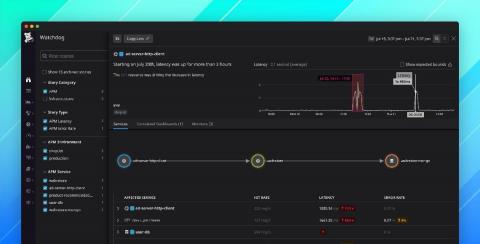
Since 2018, Watchdog has provided automatic anomaly detection to notify you of performance issues in your applications. Earlier this year, we introduced Watchdog for Infra, enhancing Watchdog to also monitor your infrastructure. We’re pleased to announce the latest enhancements to Watchdog, which now provides more visibility and greater context around the full scope of each application issue.
As part of Rancher 2.5, we are excited to introduce a new, simpler way to install Rancher called RancherD. RancherD is a single binary you can launch on a host to bring up a Kubernetes cluster bundled with a deployment of Rancher itself. This means you just have one thing to manage: RancherD. Configuration and upgrading are no longer two-step processes where you first have to deal with the underlying Kubernetes cluster and then deal with the Rancher deployment.
Amazon EKS is the most popular managed Kubernetes solution. DevOps teams can quickly spin up clusters in the cloud and get started with Kubernetes in a few clicks. As organizations embrace Kubernetes in the cloud, the challenge becomes managing clusters across multiple regions or accounts. At that point, organizations struggle to visualize all of their clusters.
Despite the lockdown restrictions of the last six months, I'm delighted to announce that we've released Rancher 2.5 on schedule today. This latest release represents another major milestone of Rancher's "Computing Everywhere" strategy by delivering management capabilities that match the extraordinary popularity of Amazon EKS and our lightweight Kubernetes distribution, K3s.
The ability of Kubernetes to easily deploy and manage containerized software has given organizations tremendous capabilities in their cloud services, with clusters multiplying into the hundreds or thousands and extending out to the edge for any number of purposes. But its growing popularity has also led to challenges in managing complexity in an environment that is conducive to cluster sprawl.