Operations | Monitoring | ITSM | DevOps | Cloud

What AI compresses, and What it Amplifies

Adam Berman, VP of Engineering at Semgrep, on the double edge of AI tools for engineering leaders: they compress the distance between an idea and a working prototype, letting him get from exploration to a demoable POC in the gaps between meetings. But that same leverage amplifies risk. One person can spin up 1,000 unowned problems just as fast as they can spin up 1,000 wins. From a Braintrust by Cortex conversation on how AI is changing the job of engineering leadership.

Workspace now reads your tickets and automates the fix

IT teams don’t need another place to look for problems. They need a faster way to understand what is happening, decide what to do next, and act before disruption spreads. That has always been the promise of Workspace. It gives IT teams a conversational way to investigate issues, surface insights from Nexthink data, and understand what needs attention across the digital workplace. Now, Workspace is entering its next phase.

Your Framework Doesn't Have to Be on Our List: How MCP Server Deployment Changes Everything

To deploy an application we haven't seen before, we need two things out of its repository. One is a Dockerfile that builds it. The other is a service definition saying what runs, which ports it listens on, which databases it needs, and what environment variables it expects. Customers arrive with a git URL, and we figure out the rest. We even do the tricky task of generating a Dockerfile if it doesn't already exist in the codebase. We've built a solution for this twice already.

Debug AI agents wherever they run, from Slack bots to code review with Sentry's Agent Tracing

Agent Tracing shows the full execution path of an AI agent: the model call, every tool invocation and its arguments, token counts, cost, and the span where it broke. Same traces and spans you already use, with agent-specific attributes on top. Serge walks through three apps — a Next.js e-commerce agent using the AI SDK with a failing tool call, a Slack bot built with Eve that orders lunch, and a code review agent built with Flue over MCP.

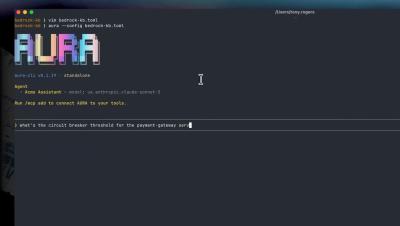
Run an AI SRE Agent Entirely Inside AWS with Bedrock and S3: AURA

An on-call question returns the threshold and the escalation owner from your own runbooks, and the answer comes back without a call to anyone outside. AURA runs against Bedrock as its model provider, using Claude Sonnet 5 served by AWS in the same region. Authentication is the normal AWS credential chain: a profile on a laptop, an IAM role in EKS.

The EU Is Starting to Put Labels on the Synthetic Internet

It's getting harder and harder to distinguish between content produced by people and content produced by machines on the internet. AI can now create convincing articles, images, audio and video that may not be immediately recognized as being AI-generated. Europe has decided that this uncertainty cannot be left to users to deal with on their own. The EU AI Act introduces new transparency obligations, which are beginning to establish a more structured framework for identifying synthetic content.

Backspaces, Retypes, and Idle Time: The Small Signals That Make a Draft Look Genuinely Written

A backspace that fixes a typo. A five-second pause before a hard sentence. A word typed, deleted, and replaced with a better one. A cursor that sits idle for two minutes while the writer stares at the screen. None of these moments feel significant while they are happening. They are the ordinary texture of writing, so automatic that most writers never notice them. But together, they are what separates a document that reads as genuinely drafted from one that reads as simply deposited.