Operations | Monitoring | ITSM | DevOps | Cloud

The latest News and Information on AIOps, alerting in complex systems and related technologies.

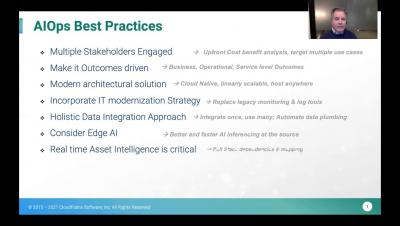
Not knowing real time asset intelligence is a non starter

Complexity breaks correlation. Intelligence brings cohesion. This simple principle is what makes real-time asset intelligence a must-have for AIOps that is meant to diffuse complexity. To further create a context for the user, it is critical to understand service dependencies and correlate alerts across the stack to resolve incidents. CMDB systems have been useful to break down configuration items into logical layers. But, that’s not enough because they can become outdated very soon.

5 AIOps Trends for 2021

Recently, there has been a steep rise in the research and utilization of Artificial Intelligence (AI). While AI once seemed like nothing more than a fantasy from a sci-fi movie, AI technology is now very much a reality in our everyday lives. Artificial intelligence and machine learning are involved in many of our daily tasks, from search engines that finish your thought, to pulling up directions in Google Maps, and how your Facebook and other social feeds are so perfectly catered to your interests.

MSPs Evolve with AIOps

AIOps is fast changing from a technology that was viewed with skepticism to an industry-changing innovation responding to the challenges of managing multifaceted, hybrid IT environments. Recently, our partner Pinnacle Technology Partners (PTP) hosted a panel discussion entitled: “Improving IT Management & Automation with AIOps,” led by Gary Derheim, VP of Managed Services & Marketing at PTP who interviewed executives and technical experts from PTP and OpsRamp.

Coffee Break Webinar Series: Intelligent Observability for IT Ops

IT Operations teams are often the bedrock of the digital business, ensuring that processes and services continue humming smoothly as developers continue to evolve and increase customer value. But increasingly complex systems can flood them with alerts that get in the way of operators from doing their best work and paving the way for new, innovative services.

PagerDuty for AIOps & Automation: Innovate & Automate Faster

We continue to improve our AIOps and machine learning capabilities to help customers reduce noise, quickly identify root cause, and automate the resolution of critical, business-impacting issues. This will help organizations further increase cost savings, reduce mean time to resolution (MTTR), and preserve people hours. The following capabilities empower responders to gain control, deliver critical context for faster root cause identification, assess impact, and automate actions with minimal configuration.

ITOps In 2 Minutes | AIOps vs MLOps | Jay Menon

The OpsRamp IT operations management (ITOM) platform allows you to see everything in your hybrid IT environment, take the right action faster with integrated event and incident management and automate with confidence with AIOps. Learn more about our service-centric AIOps platform. With OpsRamp, you can detect and resolve incidents faster, understand resource dependencies and avoid costly performance issues that result in lost revenue and productivity.

AIOps POC no longer have to be long and resource intensive

Gartner predicts that large enterprise exclusive use of AIOps and digital experience monitoring tools to monitor applications and infrastructure will rise from 5% in 2018 to 30% in 2023. And this prediction is soon turning into a reality. AIOps is showing promising business value as it impacts measurable metrics such as mean time to detect (MTTD), mean time to acknowledge (MTTA), mean time to restore/resolve (MTTR), service Availability, percentage of automated versus manual resolution, and so on.

10 Ways to Get Ahead with OpsRamp's AIOps

IT operations departments in larger enterprises often use 10-15 monitoring tools across different teams to track the health and availability of their core business services. Rather than helping ITOps teams gain a comprehensive view of their infrastructure, an overload of monitoring tools tends to only compound organizational silos and limit insights for incident troubleshooting. Yes, there is too much of a good thing.