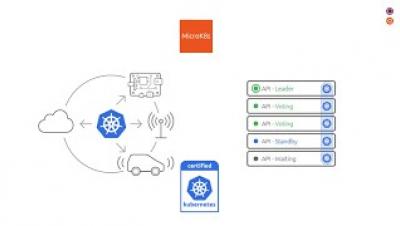
What is MicroK8s?
An introduction to MicroK8s: Canonical's lightweight distribution of Kubernetes that can be installed on any machine in under 60 seconds.


The latest News and Information on DevOps, CI/CD, Automation and related technologies.
“With Rancher and Kubernetes, we’ve started moving to a microservices architecture. What this means is our teams don’t have to know Kubernetes inside out, just the projects they’re working on. Rancher simplifies Kubernetes for technicians, which results in greater agility and innovation.” Tertius Wessels, Senior Vice President of Engineering, Entersekt We’ve all heard about high-profile security hacks and have no doubt been the recipient of phishing emails.
Heroku meets the needs of individual developers who want to deploy their applications seamlessly. The only requirement is to use a git repository and link your git repository to your Heroku account. However, for startups, Heroku has limitations. Those arguments make most of the startups moving away from Heroku to a more flexible place like AWS - which has 31% market share in Q2 2020.
Engineering teams that build, scale, and manage cloud-based applications on AWS know that at some point in time, their applications and infrastructure will be under attack. But as applications expand and new features are added, securing the full scope of an AWS environment becomes an increasingly complex task. To add visibility and auditability, AWS CloudTrail tracks the who, what, where, and when of activity that occurs in your AWS environment and records this activity in the form of audit logs.
Amazon’s EKS service (Elastic Container Service for Kubernetes) allows you to create a Kubernetes control plane in your AWS account without having to configure Kubernetes master nodes, etcd, or the api servers. In this blog post we will cover the motivation for using EKS, the preparation required to create an EKS cluster, how to configure EKS in Terraform, and how to set up kube2iam with EKS.
As with most commercial products, software today is mass produced for reasons of simple economics. But making the same software work for as many people as possible while also meeting the unique requirements different people and organizations have is a challenging task.
HashiCorp Packer is a free and open source tool for creating golden images for multiple platforms from a single source configuration. Packer makes it easy to codify VM images for Microsoft Azure. In this blog post we’ll look at how to use HashiCorp Packer and Puppet Bolt to define our VM templates in code.