Operations | Monitoring | ITSM | DevOps | Cloud

The latest News and Information on DevOps, CI/CD, Automation and related technologies.

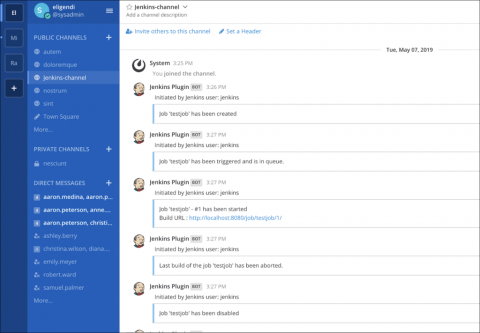
Build better workflows: Announcing the Mattermost DevOps integration set

No matter what tools your team uses, more effective collaboration results from sharing information and context, being able to react quickly, and automating repetitive processes. Development teams move faster when they can consolidate information in one central hub and can reduce context switching by switching less between different tools.

Maximize Observability of your CI/CD Pipeline with LogDNA

Continuous integration and continuous deployment (CI/CD) has enabled teams to build and deploy software at a much faster pace. DevOps teams can build, test, and deploy changes to production in a matter of minutes, allowing for extremely rapid release cycles. However, a CI/CD pipeline has a lot of moving parts and steps where problems to occur. In order to ensure a successful deployment, it’s important to monitor each step in this process.

Get Going with SNS

Every day that I commute home, I check Google Maps for the next Trimet bus arrival at the usual stop. There’s nothing wrong with this ritual but it always distracts or leaves me stalled for a few empty minutes. Ever the proponent of laziness automation, I decided to build a stack that will do this for me by texting incoming arrival times for my bus home.

Why You Should Use API Gateway Proxy Integration With Lambda

Ben Kehoe wrote a post about AWS API Gateway to Lambda integration: How you should — and should not — use API Gateway proxy integration with Lambda. In his post, Ben gave a few reasons why he believes using API Gateway Proxy Integration is an anti-pattern. Ben does a great job summarizing how the integration works. He writes: The pattern that I am recommending against is the “API Gateway proxy integration” as shown in the API Gateway documentation here.

Docker Build: A Beginner's Guide to Building Docker Images

Docker has changed the way we build, package, and deploy applications. But this concept of packaging apps in containers isn’t new—it was in existence long before Docker. Docker just made container technology easy for people to use. This is why Docker is a must-have in most development workflows today. Most likely, your dream company is using Docker right now. Docker’s official documentation has a lot of moving parts. Honestly, it can be overwhelming at first.

The Three Pillars of Kubernetes Observability

The three pillars of observability are metrics, logs, and traces. To get a complete view into your applications as well as the Kubernetes platform they run on, you need to be looking at all the different perspectives. In this session, we will look at each pillar to see how we can use the information collected to understand what is happening in our environment today and how to troubleshoot the problems we experience tomorrow. We will share how to do this using various open source tools as well as using the Datadog platform.

Automate workflows with Datadog's Amazon EventBridge integration

Amazon EventBridge is a serverless event bus that routes real-time data streams from your applications and services to targets like AWS Lambda. EventBridge facilitates event-driven application development by simplifying the process of ingesting and delivering events across your application architecture, and by providing built-in security and error handling. We are excited to announce that you can now use our new integration to route Datadog alerts to EventBridge with minimal configuration or setup.

Cross-tenant monitoring with Azure Lighthouse and Datadog

Azure Lighthouse is a new feature that provides improved access management for users and applications across different Azure tenants. With Azure Lighthouse, managed service providers (MSPs) can manage their customers’ environments more easily and efficiently than ever before. Datadog is proud to announce support for Azure Lighthouse, which ensures that MSPs can implement a streamlined, scalable approach to monitoring their customers’ Azure environments.

Three Reasons You Should Consider Hiring a Financial Cloud Operations Manager

If you're running in the cloud and ever struggle to predict, report on, or attribute your cloud costs, you may want to consider a new kind of role: A Financial Cloud Operations Manager. While a traditional cloud operations manager may sit on the DevOps team or report to an engineering lead, a financial cloud ops manager’s reporting structure is slightly different.