Operations | Monitoring | ITSM | DevOps | Cloud

OpenSearch 3.6: Agentic Applications Meet Long-Term Support

TL;DR OpenSearch 3.6 makes agentic search production-ready, with the AI-powered Launchpad provisioning full search apps in minutes and faster default vector search, and it's the first LTS release, bringing 18+ months of guaranteed support, SBOMs, and an upstream-first commitment (every fix goes back to the main project) so teams get fast-moving open source and a stable, supported platform at once.
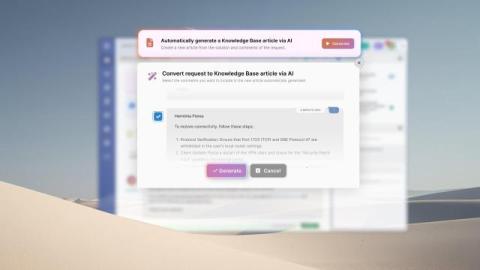

How to Use Your Knowledge Base to Increase AI Chatbot Deflection

Ticket deflection is the metric IT leaders point to when they talk about AI chatbot ROI, and the knowledge base is the part of the equation that determines whether that number moves. A chatbot can run natural language processing well and still deflect almost nothing if the content behind it is thin, outdated, or scattered across articles that don't match how people actually ask questions.

Why AI agents need a job description | The future of agentic AI in IT

An AI agent is only as useful as the job you can safely hand it. In this Zero Ticket Minute, Ian Coppock, Resolve Customer & Partner Marketing Manager, breaks down why enterprise AI is moving toward purpose-built agents with defined roles, scoped permissions, and real guardrails. That is the foundation for autonomous IT operations and Zero Ticket IT. Subscribe for weekly insights on AI, IT automation, and where enterprise operations are heading.

15 Best AI Observability Tools for Production Teams in 2026

AI applications generate far more than model outputs. Every request includes prompts, retrieval, tool calls, agent steps, latency, token usage, and evaluation signals that all contribute to the final response. When something goes wrong, engineering teams need to understand what happened, why it happened, what it cost, and whether the outcome met quality expectations.

Observability vs. Monitoring for AI Systems

Monitoring tells you when an event you predicted has actually happened. Observability lets you investigate behavior you may not have predicted at all. For most of the past decade, that distinction was something teams could afford to treat as a philosophical debate, because their systems failed in expected ways that had been seen before. A memory leak, a bad deploy, a saturated connection pool. You could build a dashboard and alerts for each and sleep reasonably well.

Why Cash Flow Still Matters in an AI-Driven Economy

Artificial intelligence is changing how businesses operate. Companies are using AI tools to automate customer service, generate content, analyze data, improve forecasting, and streamline everyday tasks. For many business owners, the promise is simple: work faster, reduce costs, and improve efficiency.

Building AI SRE Agents, Part 1: Start Local, Break Things, Learn Fast

The first stage of AI SRE maturity is a laptop, a throwaway cluster, and zero production access. Here’s how to set it up, and what to watch for. AI SRE (Site Reliability Engineering) agents are AI-powered systems that automate the most time-consuming parts of incident response: triaging alerts, correlating logs and metrics, generating root-cause hypotheses, and proposing remediation steps.