Operations | Monitoring | ITSM | DevOps | Cloud

The latest News and Information on DevOps, CI/CD, Automation and related technologies.

Humanizing a DevOps Transformation

Anyone who’s ever played the game of chess knows there’s more than one way to reach a desired outcome. There are 400 possible setups after the first turn; 197,742 after the second; and just north of 120 million after the third—all of which are marching toward the same desired outcome. “So, what does any of this have to do with DevOps?” you ask? Fair question.

8 Tips for SRE Wellness

When planning the SRE from home virtual even last month, one of the central themes was wellness and the need for self-care for SREs, especially during this time of crisis. Knowing how stressful an SRE’s day can be, combined that with a global pandemic and new working conditions, we knew we needed programming around SRE and IT wellness for SRE from Home. We’re all looking for ways to maintain a healthy work-life, but hearing this from your peers was especially important.

Accidental Cloud Administrator

Accidental DBA is a term most IT pros are familiar with, and traditionally it describes an “on-top task” for the SysAdmin. It was followed by the “involuntary security admin,” a task carried out by network admins, as back in the days it was all about securing the perimeter. Now there are the clouds, but whose responsibility is it? Surely the SysAdmin again, as it’s just about infrastructure? But then there’s VPNs and BGP and load balancers—network territory!

Use HAProxy Response Policies to Stop Threats

HAProxy gives you an arsenal of sophisticated countermeasures including deny, tarpit, silent drop, reject, and shadowban to stop malicious users. There are two phases to stopping malicious users from abusing your website and online applications. Step one is detection, step two is deploying countermeasures. HAProxy is more powerful than nearly every other load balancer when it comes to both detection and countermeasures.

Installing the HAProxy Kubernetes Ingress Controller using Helm

Helm, the Kubernetes package manager, revamps the way teams manage their Kubernetes resources and allows them to deploy applications in a consistent and reliable way. It is a valuable tool in a continuous delivery pipeline, with support for quick updates and rollbacks. At HAProxy Technologies, we offer Helm as the preferred method for installing the HAProxy Kubernetes Ingress Controller, and we’ll show you how to customize that installation to fit your use case.

What is PostgreSQL, and why do developers love it?

(Want your cloud apps managed? Reach out to Canonical now. You can also watch our webinar on why you should get your apps managed, and get your application reviewed by our app engineers.) PostgreSQL solves the problem of extensibility, in complex cloud environments. This statement is often thrown around, but why is it true? Should next-generation cloud-infrastructure still use it? Is it still relevant in an era of big data?

10 Helm Tutorials to Start your Kubernetes Journey

The growth of Kubernetes has been stellar and K8s applications have grown in importance and complexity. Today, even configuring a single application can require creating many interdependent K8s sources that each depend on writing a detailed YAML manifest file. With this in mind, Helm as a package manager for Kubernetes is a major way users can make their K8s configurations reusable.

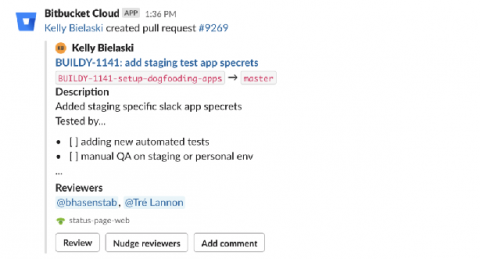
4 Bitbucket and Slack hacks to speed up your workflow, from actual devs

While working from home is the new normal, communicating and collaborating virtually hasn't become any easier. And for developers, being productive while at home has its own set of challenges (we're thinking of things like figuring out how to pair program over Zoom or how to make do with only a single monitor). In times like this, our engineering team has been relying on one short-cut towards productivity: the Bitbucket Cloud bot for Slack.

In-house vs. MetricFire

You’re ingesting 20,000 data points a second, in 400,000 metrics, from thousands of AWS instances – and your monitoring can’t handle the load. You need a scalable, highly-available monitoring and dashboarding solution (and you need it yesterday). Should you do it yourself with an in-house Graphite or Prometheus monitoring system? Or will you skip the headache and choose a hosted service like MetricFire?