Operations | Monitoring | ITSM | DevOps | Cloud

The latest News and Information on DevOps, CI/CD, Automation and related technologies.

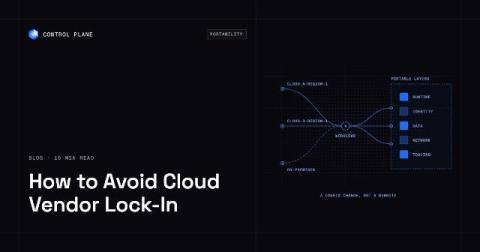
How to Avoid Cloud Vendor Lock-In: A Practical Guide for 2026

You avoid cloud vendor lock-in by keeping the parts that are expensive to move portable: the compute runtime, identity, data, networking, and deployment tooling. You accept proprietary services only where their value clearly exceeds the exit cost, so that leaving or adding a provider is a configuration change rather than a rewrite.

Stacked PRs: what they are and how to run CI on a stack

Large pull requests can be a pain to review. When a change touches dozens of files and adds hundreds of lines of code, reviewers have a lot to work through before they can approve it. And if something needs to change, the whole PR goes through another round of review. Stacked PRs let developers split a large change into smaller, dependent pull requests that can be reviewed separately.

AI Coding Assistants: Trust Is the Attack Surface

Explore how AI coding agents can be exploited through trusted files, hooks, and MCP tools, and learn how to secure agent workflows against hidden instructions and persistent threats. Why the most dangerous instructions aren't the ones you type into the chat box For the past decade, autocomplete guessed your next line. It was helpful, annoying, or flat-out wrong, depending on the day.

Burnout Is Rising. Here's What You Can Fix

The faster teams deploy, the more releases fail, and burnout climbs right with it. What 700 engineers told Harness about AI-scale delivery. Lenny's Newsletter put out its 2026 tech workforce survey this year, and you should read the whole thing. The headline stats: significant burnout jumped from 44.7% to 55.7% of tech workers in a year. Career optimism dropped from 54.8% to 48.7% over the same period of time.

How to lower Android development costs by removing hardware from the critical path

As an Android developer, you’ll almost always have access to a device. However, when handling hardware, the device that you actually need often happens to be already in use, set up incorrectly, stored in another lab, or simply waiting to be reset. That’s when Android development costs start to increase.

When AI Attacks at Machine Speed, Configuration Management Becomes Cybersecurity

The Australian Medicare AI agent incident highlights a broader shift in cybersecurity. AI does not need to create new vulnerabilities to increase risk. Its ability to continuously discover, test, and pursue existing weaknesses places greater emphasis on maintaining secure configurations over time, not just fixing issues once. Security teams are used to the idea that determined attackers will keep looking for a way in.

AI infrastructure costs in 2026: what the stack is, what each layer costs, and how much to commit

AI infrastructure costs span four buying tiers in 2026: API-only teams spend hundreds to tens of thousands per month on tokens, GPU renters typically pay $2 to $10 per GPU-hour by chip class, committed-capacity buyers sign six-to-eight-figure reservation contracts, and owners spend millions per rack. The stack has six layers, and most budgets underestimate everything below the GPU line.

How CFOs can control AI spend and prove AI's value

Neil Sawyer, Senior Vice President and Managing Director for HP Europe, Middle East and Africa, recently published “Scaling AI Without Losing Control” in Forbes Business Council. His starting point will be familiar to any finance leader. AI pilots looked affordable on pay-per-token and pay-per-query pricing, and that same pricing can get far more expensive at enterprise scale. Gartner forecasts worldwide AI spending will reach $2.7 trillion in 2026, up 49.5%.

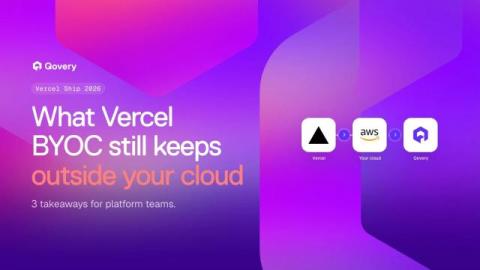
Vercel Ship 2026: 3 Takeaways, and What Vercel's BYOC Still Keeps Outside Your Cloud

Vercel Ship 2026 made three things clear: Vercel wants your backend, agents now trigger most deployments, and Bring Your Own Cloud on AWS is GA. Here is what each announcement means for platform teams, what Vercel BYOC actually runs in your AWS account, and what it leaves on Vercel. Romaric founded Qovery to make Kubernetes accessible to every engineering team. He writes about platform strategy, developer experience, and the future of cloud infrastructure.