Operations | Monitoring | ITSM | DevOps | Cloud

The latest News and Information on DevOps, CI/CD, Automation and related technologies.

Unable to get local issuer certificate, explained

Your site loads in Chrome fine. Then a deploy script, a webhook, or integration calls the same URL and gets this: Python says certificate verify failed: unable to get local issuer certificate. Node says unable to get local issuer certificate, or unable to verify the first certificate. It’s all the same problem. It’s a misconfiguration between your certificate and a trusted root. Either the server isn’t sending it, or the client doesn’t have it.
How SGP.32 unlocks next-generation IoT deployments

Every time a smart utility meter transmits consumption data, a connected vehicle updates its telemetry, or a fleet of logistics trackers crosses international borders, seamless and uninterrupted connectivity is vital. Yet for years, managing Internet of Things (IoT) devices at scale has been constrained by physical SIM logistics, operator lock-in and remote SIM provisioning standards that were simply never built for autonomous, resource-constrained hardware.

AI wrote the bug. You need production data to reproduce it

A pull request lands with a function an AI assistant generated. It reads cleanly, passes the existing tests, and gets merged. Three weeks later it breaks, but only for accounts with a specific billing history. Nobody wrote a test for that condition because nobody was thinking about it when the code went in. Now someone has to debug logic they didn't reason through, against a failure they can't picture without the exact data that triggered it. Debugging someone else's code has always worked this way.

Autonomous IT: Data, Context, and Governed Action | 2H Announcement from LogicMonitor

Autonomous IT requires three things: complete, AI-ready data; connected context; and governed action. In LogicMonitor's 2H announcement, we show enterprise IT and ITOps leaders how each layer works. LogicMonitor is the AI-first platform for Autonomous IT. This update covers the three layers behind autonomous IT operations as the category moves from systems of intelligence to systems of action. Your team decides when Edwin AI moves from recommending an action to taking it.

LM Logs Tips: Alert-to-Logs Workflow for Ops Team | Logs for Lunch

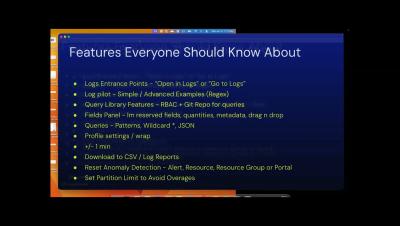
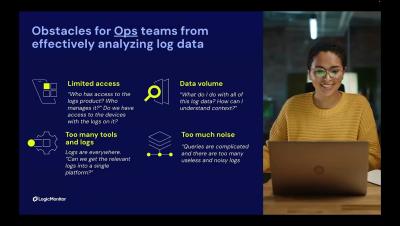
LM Logs troubleshooting starts at the alert. This Logs for Lunch session shows ITOps teams an alert-to-logs workflow and lesser-known LM Logs tips. Ryan Matuszewski demos a Tomcat application error. From the alert's Logs tab, he moves through log anomaly detection, All Logs, Log Patterns, and Log Analysis sorted by sentiment. He then opens the Logs page with the alert time range, and the same steps work for any alert type.

Cloud Log Monitoring & Root Cause Analysis | Logs for Lunch

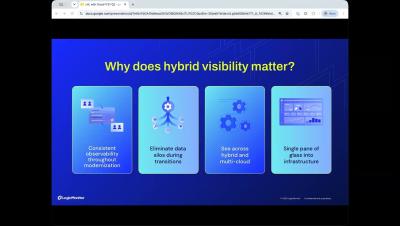
Cloud log monitoring in LogicMonitor connects a service alert to the log event behind it. This Logs for Lunch July demo is for ITOps, CloudOps, and SRE teams. Tom Chavez hosts Ismath Mohideen (Product Marketing) and Nick Doane (Senior Sales Engineer). They cover cloud observability and multi-cloud monitoring across AWS, Azure, GCP, and OCI in LM Envision, using cloud provider APIs with no extra collectors.

SNMP Traps as Logs and Network Troubleshooting | Logs for Lunch

SNMP traps as logs, AI log anomaly detection, and network troubleshooting are the focus of Logs for Lunch: August 2026, for network and IT ops teams and LogicMonitor users. Tom Chavez introduces LM Logs, which keeps logs and metrics together. Cameron Compton troubleshoots dropped tunnel packets from a network operations dashboard, and Ron Scinta ingests SNMP traps through the Collector. Patrick Sites and Kerry DeVilbiss answer questions on load balancing, OTel and Cribl forwarding, MSP log sources, and search performance.
Featured Post

AI Is Making Infrastructure Easier to Create and Harder to Operate

AI is rapidly changing the economics of software engineering. Tasks that once required hours of engineering effort can increasingly be completed in minutes. An AI agent can write an application, generate Terraform, produce Kubernetes manifests, configure a CI/CD pipeline, and interact directly with cloud APIs. For infrastructure teams, this sounds like an enormous productivity win. And on Day 1, it is. But generating infrastructure has never been the hardest part of running it.
Featured Post

The hidden cost of IT sprawl: how fragmented infrastructure drains business performance

Most IT estates grow through years of individual decisions instead of a single plan. A cloud account gets opened for one project. A data centre contract stays in place because switching is a migration project the business keeps deferring. Those choices get made workload by workload, and the estate that results rarely holds together as one plan.